--------- #1345 - Absolute Zero Temperature Strangeness?
- Attachment: none
- Absolute Zero is the lowest temperature can get. It is zero degrees Kelvin ,or, -273 degrees Centigrade. Temperature is the measurement of the vibration of atoms. We feel atom vibrations as “heat”. Vibrating can also emit infrared radiation that we can also feel as heat. Another way we can feel the heat is through convection. Vibrating atoms and infrared radiation vibrate the molecules in the air. These molecules move throughout the room and bring a warm feeling to your skin. The absence of heat is reduction of the vibration of atoms and it is called “cold”. Just as “dark” is the absence of “light”.
- Absolute Zero is a cold as it gets. When the vibration of atoms stops you are there. Of course, the quantum jitter of atoms never stops. So, atoms and particles, can not be completely stopped regardless. This is defined as the principle of Quantum Uncertainty. Not a topic for this review. This review is about temperature and about the vibration of atoms which is the energy of motion.
- The energy of motion is called “ Kinetic Energy”. The faster the motion the more the Kinetic Energy the hotter it feels. It is also know as “Thermal Energy”. The measurement of Thermal Energy is called temperature. As atoms slow down and they reach lower temperatures they can change state. Different elements and different molecules change states at different temperatures.
- Water vapor is a gas above 100 degrees Centigrade. When the temperature falls below 100 C the gas changes state into a liquid. When the temperature falls down below 0 C the liquid changes state and becomes solid ice.
- The measurement of temperatures is an arbitrary number. Science simply chose the states of pure water to set the values of 100 degrees between the two states. But, science also learned that the states and temperatures also depend on pressures. Not all situations could be read at atmospheric pressure at sea level. Ammonia gas, for example, liquefies at 132.4 Centigrade and 111.3 atmospheric pressure.
- The pressure affects the vibration of atoms also. Higher pressures can keep atoms form vibrating as much just as lower temperatures are reduced vibrations. Ammonia gas turns into a gas at room temperatures and pressures. This property is used in refrigeration. A gas absorbs a small amount of heat from its surroundings when it changes states from a liquid to a gas.
- In a closed system, a compressor motor outside the refrigerator increases the pressure and turns the gas into a liquid. The liquid is pumped inside the refrigerator and released into coils of tubes that are at atmospheric pressure. When the liquid is released the change of state into a gas absorbs heat from inside the refrigerator. The gas is pumped back outside the refrigerator where the compressor changes it back into a liquid and the heat is released into the kitchen.
- Science studied many different gases to learn at what temperatures and pressures each changed state into a liquid. Plotting this data temperature versus pressure proved to be a linear relationship. The plot was a straight line as pressure increased and temperature decreased liquefaction of gases occurred. However, some gases simply refused to liquefy regardless of how much pressure was applied. This happened with ordinary air.
- The air was mostly nitrogen and they decided that the temperatures were just not low enough for liquefaction to occur. Here is what they discovered as temperatures were reduced lower and lower:
------------------ Water Vapor ----------- 373.946 C -------- 217.7 atmospheres
------------------ Ammonia -------------- 132.4 C ----------- 111.3 atmospheres
------------------ Oxygen ----------------- (-118.6 C) --------- 49.8 atmospheres
------------------- Nitrogen ---------------- (-146.9 C) ---------- 33.5 atmospheres
----------------- Hydrogen ---------------- (-239.95 C) ---------12.8 atmospheres
------------------ Helium ------------------ (-267.96 C) ---------- 2.24 atmospheres
- Liquid helium enters some very unusual states caused by atoms behaving within Quantum Mechanics theory at these temperatures. One is “ Super fluidity” Helium liquid will have zero viscosity and infinite thermal conductivity. With zero viscosity the liquid helium will flow uncontrollably and it will always maintain he exact same temperature throughout. Liquid helium will actually rise up the sides of its container over the top and down to spread across the table. It is impossible to set up a thermal gradient in this fluid. Application of heat at a spot will conduct at 20 meters per second to bring the entire liquid to the same temperature.
- A phonon is a mechanical vibration ( like a sound vibration ) is a lattice structure of atoms at a resonance frequency. Superconductivity is like a superfluid for electrons that can travel through a conductor lattice structure with zero resistance. Just as a temperature gradient can not be created across a superfluid, a voltage gradient can not be created across a superconductor.
- Superconductivity occurs because of the inter action between electrons and the vibrating lattice of ions in the conductor. With a resonant phonon two electrons can pick up this oscillating frequency and become a “ Cooper Pair” of electrons. The paired electrons can be 100 nanometers apart while the ions in the lattice are 0.1 to 0.4 nanometers apart. In a superconductor cooled to a critical temperature the Cooper Pairs move through the conductor in a coordinated way. Resistance can not occur because a large number of coordinated pairs would have to be slowed down all a once.
- Once superconducting occurs no magnetic field can penetrate the conductor. this can have the effect of levitating the superconductor above a permanent magnet. ( See Meisner Effect”) .
The plot of temperature versus is a straight line. To define the degrees Kelvin one end of the sloped line is a zero temperature and zero pressure. The other end of the line is the Triple Point for pure water. The Triple Point is where temperature and pressure are just right to allow water vapor, water liquid, and water ice to all exist at the same time. All three states of water matter are present at 273.16 Centigrade and 4.58 millimeters of mercury pressure. The straight line between the points defines the temperatures in degrees Kelvin.
- The straight line extends from Absolute Zero to the temperature of the Big Bang. It goes from zero degrees Kelvin to 350,000,000,000,000,000,000,000,000,000,000 degrees Kelvin. Now that is hot. To learn how this temperature calculation was made see Review #727 , Absolute Zero Temperature. Or, #1346 How Hot is it at the Big Bang?
---------------------- ------------------------------------------------------------------
RSVP, please reply with a number to rate this review: #1- learned something new. #2 - Didn’t read it. #3- very interesting. #4- Send another review #___ from the index. #5- Keep em coming. #6- I forwarded copies to some friends. #7- Don‘t send me these anymore! #8- I am forwarding you some questions? Index is available with email and with requested reviews at http://jdetrick.blogspot.com/ Please send feedback, corrections, or recommended improvements to: jamesdetrick@comcast.net.
or, use: “Jim Detrick” www.facebook.com, or , www.twitter.com.
707-536-3272, Wednesday, December 7, 2011
Wednesday, December 7, 2011


How hot was it at the instant of the Big Bang?
--------- #1346 - How Hot Was It at the Big Bang?
- Attachment: Big Bang
- The temperature of the Universe is inversely proportional to its size. As the Universe expands the temperature decrease. Today it has expanded and cooled to a temperature of 2.725 degrees Kelvin. That is 2.725 degrees above Absolute Zero. (see footnote 1). What would happen if we reversed the expansion and sent time collapsing back to the Big Bang. The temperature would get hotter and hotter. The pressure would get greater and greater.
- It turns out that the temperature / pressure relationship is a linear relationship. Plotting temperature versus pressure we get a straight line all the way back to the Big Bang. Therefore, we should be able to use the laws of physics and extrapolate back to the Big Bang to determine how hot it was. The math used is called “dimensional analysis.” It is a simple concept. To learn it we will try it out on a pendulum before we try it out on the Universe.
- Measurements in physics and astronomy can involve 3 dimensions: length (space), time, and mass (energy). We refer to these as dimensions and they are measured in units: meters, seconds, kilograms. Starting with the pendulum let’s use these three dimensions to calculate the period of the pendulum swing. The pendulum is a mass hanging freely on a string and swinging back and forth. The period is the time for one cycle of one swing.
- The period is “time“, it is possibly a function of the three dimensions ,length, time, and mass to some degree. The force on the mass is a function of gravity. If we are on the surface of the Earth the acceleration of gravity is 9.8 meters / second^2 ( 32 feet per second per second.). We might also guess that the period might be a function of the length of the strength, and the weight of the mass. Guess:
------------------ Time = mass * length * acceleration of gravity
---------------- Acceleration of gravity = “g” = (length / time ^2) = (m / sec^2)
-------------- Working with the units of each dimension, try to derive the equation for the period of a pendulum: To get to the equality seconds = seconds.
--------------- second = kilograms * meters * meters / second^2
---------------- Working to cancel the units on the right side of the equation to equal the left side of the equation, which is seconds. Let’s divide by the acceleration of gravity , (meters / seconds^2)^-1
------------- sec = kg * m / m / sec^2
-------------- Squaring the left side to get sec^2. There are no kilograms on the left side of the equation , so, mass must not be a factor. The period of a pendulum is the same regardless of the weight of the mass. Therefore, we can guess the equation for the period of a pendulum to be:
-------------- ( period )^2 = length / acceleration of gravity
--------------- T^2 = L / g
-------------- sec^2 = m^ / m /sec^2
- And, that works. The period is directly proportional to the length of the string. The longer the string the longer the period. It is inversely proportional to the acceleration of gravity. The pendulum would have a longer period swinging on the Moon. The period would be independent of the mass, as long as the string did not break.
- The pendulum illustrates how you can solve a problem just by thinking through the dimensions involved and the units of measurement. Now, you are ready to derive the equation for the temperature at the instant of the Big Bang:
- The three fundamental dimensions are length, time and mass. Our plan will be to use the 3 fundamental constants in Nature: “h“, “c“, and “G“. Use these to calculate the Energy of the Big Bang from E= mc^2. Then use Boltzman’s Constant to convert Energy to temperature. First let’s define the 3 fundamental constants of Nature:
-------------------- h = Planck’s Constant of Action. Action is the product of Energy and Time.
-------------------- h = 6.6*10^-34 kilograms * meters^2 / second
-------------------- h units = kg * m^2 / sec
--------------------- c = (speed of light)
--------------------- c = 3*10^8 meters / second
-------------------- c units = (m / sec)
-------------------- G = Gravitational Constant
--------------------- G = 6.7*10^-11 meters^3 / ( kilogram * seconds^2)
--------------------- G units = m^3 / ( kg*sec^2)
- Using E = mc^2 all we need is Mass to calculate Energy. We know the speed of light. Putting Mass in terms of the units of the fundamental constants: To get the equation to balance we need kilograms in the numerator. One way to do that is to start with “ G” in the denominator:
--------------------- kilograms = 1/ G = ( kg * sec^2) / m^3
- Now, to cancel out sec / meter we multiply by “c” which is in m / sec:
------------------ kilograms = c / G = ( kg * sec^2) / m^3 * m / sec
- Now, we still need to cancel more sec / meter so multiply this by “h” which is kilograms * meters^2 / sec.
------------------kilograms = c * h / G = ( kg * sec) / m^2 * kg * m^2 / sec
--------------- kilograms = c * h / G = ( kg ^2)
- Now, we need to square the left side of the equation in order to get the equality and have all the units cancel out:
--------------- (kilograms)^2 = c * h / G = ( kg ^2)
--------------- M^2 = c * h / G
- Now, we have the Mass in terms of the fundamental constants so we can substitute the values for the constants and solve for the fundamental Mass:
------------ M^2 = (3*10^8 meters / second) * (6.6*10^-34 kilograms * meters^2 / second) / (6.7*10^-11 meters^3 / ( kilogram * seconds^2))
---------------- M^2 = 2.955*10^-15 kg
----------------- M = 5.4 *10^-8 kg
- Now, we can calculate E = mc^2:
------------------ E = (5.4 *10^-8 kg) * ( 9 * 10^16 m^2/sec^2)
------------------ E = (50*10^8 kg * m^2/sec^2)
------------------ E = (5 *10^9 Joules.
- Now, using Boltzman’s constant for converting Energy to Temperature: ( See Review # 1072 to learn about Boltzman’s Constant.
--------------- T = (Kelvin / 1.381 *10^-23 Joules ) * Energy
-------------- T = (Kelvin / 1.381 *10^-23 Joules ) * (5 *10^9 Joules)
----------------- T = 3.5 * 10^32 Kelvin
- Therefore the temperature at the time of the Big Bang according to the fundamental constants was 350,000,000,000,000,000,000,000,000,000,000 degrees Kelvin. I think you needed to know that.
----------------------------------------------------------------
(1) Other Reviews that have background on this same topic:
# 1345 - Absolute zero temperature strangeness.
# 1234 - What happens when you cool an atom
# 1072 - Boltzman’s Constant, Avogadro’s Number.
# 727 Absolute zero _ TEMPERATURE
# 406 Zero is nothing, but Absolute Zero is something else.
-------------------------------------------------------------------------
(2) The same dimensional analysis method can be used to calculate fundamental time:
------------------ T^2 = G * h / c^5
------------------ T = 1.4 * 10^-43 seconds
--------------------------------------------------------------------------
(3) To calculate fundamental distance:
----------------- L^2 = G * h / c3
------------------- L = 1.62*10^-35 meters
---------------------- ------------------------------------------------------------------
RSVP, please reply with a number to rate this review: #1- learned something new. #2 - Didn’t read it. #3- very interesting. #4- Send another review #___ from the index. #5- Keep em coming. #6- I forwarded copies to some friends. #7- Don‘t send me these anymore! #8- I am forwarding you some questions? Index is available with email and with requested reviews at http://jdetrick.blogspot.com/ Please send feedback, corrections, or recommended improvements to: jamesdetrick@comcast.net.
or, use: “Jim Detrick” www.facebook.com, or , www.twitter.com.
707-536-3272, Wednesday, December 7, 2011
Monday, December 5, 2011
Absolute Zero Temperature Strangeness?
--------- #1345 - Absolute Zero Temperature Strangeness?
- Attachment: none
- Absolute Zero is the lowest temperature can get. It is zero degrees Kelvin ,or, -273 degrees Centigrade. Temperature is the measurement of the vibration of atoms. We feel atom vibrations as “heat”. Vibrating can also emit infrared radiation that we can also feel as heat. Another way we can feel the heat is through convection. Vibrating atoms and infrared radiation vibrate the molecules in the air. These molecules move throughout the room and bring a warm feeling to your skin. The absence of heat is reduction of the vibration of atoms and it is called “cold”. Just as “dark” is the absence of “light”.
- Absolute Zero is a cold as it gets. When the vibration of atoms stops you are there. Of course, the quantum jitter of atoms never stops. So, atoms and particles, can not be completely stopped regardless. This is defined as the principle of Quantum Uncertainty. Not a topic for this review. This review is about temperature and about the vibration of atoms which is the energy of motion.
- The energy of motion is called “ Kinetic Energy”. The faster the motion the more the Kinetic Energy the hotter it feels. It is also know as “Thermal Energy”. The measurement of Thermal Energy is called temperature. As atoms slow down and they reach lower temperatures they can change state. Different elements and different molecules change states at different temperatures.
- Water vapor is a gas above 100 degrees Centigrade. When the temperature falls below 100 C the gas changes state into a liquid. When the temperature falls down below 0 C the liquid changes state and becomes solid ice.
- The measurement of temperatures is an arbitrary number. Science simply chose the states of pure water to set the values of 100 degrees between the two states. But, science also learned that the states and temperatures also depend on pressures. Not all situations could be read at atmospheric pressure at sea level. Ammonia gas, for example, liquefies at 132.4 Centigrade and 111.3 atmospheric pressure.
- The pressure affects the vibration of atoms also. Higher pressures can keep atoms form vibrating as much just as lower temperatures are reduced vibrations. Ammonia gas turns into a gas at room temperatures and pressures. This property is used in refrigeration. A gas absorbs a small amount of heat from its surroundings when it changes states from a liquid to a gas.
- In a closed system, a compressor motor outside the refrigerator increases the pressure and turns the gas into a liquid. The liquid is pumped inside the refrigerator and released into coils of tubes that are at atmospheric pressure. When the liquid is released the change of state into a gas absorbs heat from inside the refrigerator. The gas is pumped back outside the refrigerator where the compressor changes it back into a liquid and the heat is released into the kitchen.
- Science studied many different gases to learn at what temperatures and pressures each changed state into a liquid. Plotting this data temperature versus pressure proved to be a linear relationship. The plot was a straight line as pressure increased and temperature decreased liquefaction of gases occurred. However, some gases simply refused to liquefy regardless of how much pressure was applied. This happened with ordinary air.
- The air was mostly nitrogen and they decided that the temperatures were just not low enough for liquefaction to occur. Here is what they discovered as temperatures were reduced lower and lower:
------------------ Water Vapor ----------- 373.946 C -------- 217.7 atmospheres
------------------ Ammonia -------------- 132.4 C ----------- 111.3 atmospheres
------------------ Oxygen ----------------- (-118.6 C) --------- 49.8 atmospheres
------------------- Nitrogen ---------------- (-146.9 C) ---------- 33.5 atmospheres
----------------- Hydrogen ---------------- (-239.95 C) ---------12.8 atmospheres
------------------ Helium ------------------ (-267.96 C) ---------- 2.24 atmospheres
- Liquid helium enters some very unusual states caused by atoms behaving within Quantum Mechanics theory at these temperatures. One is “ Super fluidity” Helium liquid will have zero viscosity and infinite thermal conductivity. With zero viscosity the liquid helium will flow uncontrollably and it will always maintain he exact same temperature throughout. Liquid helium will actually rise up the sides of its container over the top and down to spread across the table. It is impossible to set up a thermal gradient in this fluid. Application of heat at a spot will conduct at 20 meters per second to bring the entire liquid to the same temperature.
- A phonon is a mechanical vibration ( like a sound vibration ) is a lattice structure of atoms at a resonance frequency. Superconductivity is like a superfluid for electrons that can travel through a conductor lattice structure with zero resistance. Just as a temperature gradient can not be created across a superfluid, a voltage gradient can not be created across a superconductor.
- Superconductivity occurs because of the inter action between electrons and the vibrating lattice of ions in the conductor. With a resonant phonon two electrons can pick up this oscillating frequency and become a “ Cooper Pair” of electrons. The paired electrons can be 100 nanometers apart while the ions in the lattice are 0.1 to 0.4 nanometers apart. In a superconductor cooled to a critical temperature the Cooper Pairs move through the conductor in a coordinated way. Resistance can not occur because a large number of coordinated pairs would have to be slowed down all a once.
- Once superconducting occurs no magnetic field can penetrate the conductor. this can have the effect of levitating the superconductor above a permanent magnet. ( See Meisner Effect”) .
The plot of temperature versus is a straight line. To define the degrees Kelvin one end of the sloped line is a zero temperature and zero pressure. The other end of the line is the Triple Point for pure water. The Triple Point is where temperature and pressure are just right to allow water vapor, water liquid, and water ice to all exist at the same time. All three states of water matter are present at 273.16 Centigrade and 4.58 millimeters of mercury pressure. The straight line between the points defines the temperatures in degrees Kelvin.
- The straight line extends from Absolute Zero to the temperature of the Big Bang. It goes from zero degrees Kelvin to 350,000,000,000,000,000,000,000,000,000,000 degrees Kelvin. Now that is hot. To learn how this temperature calculation was made see Review #727 Absolute Zero Temperature.
---------------------- ------------------------------------------------------------------
RSVP, please reply with a number to rate this review: #1- learned something new. #2 - Didn’t read it. #3- very interesting. #4- Send another review #___ from the index. #5- Keep em coming. #6- I forwarded copies to some friends. #7- Don‘t send me these anymore! #8- I am forwarding you some questions? Index is available with email and with requested reviews at http://jdetrick.blogspot.com/ Please send feedback, corrections, or recommended improvements to: jamesdetrick@comcast.net.
or, use: “Jim Detrick” www.facebook.com, or , www.twitter.com.
707-536-3272, Monday, December 5, 2011
Saturday, December 3, 2011
Math Problem with a Rocket Launch
 --------- #1344 - Math for a Rocket Launch?
- Attachment: photo of Kennedy Space Center Night Rocket Launch
- You give your students this photo of a rocket launch at Kennedy Space Center. The night time exposure was 2.5 minutes. How far from launch did the rocket reach its orbit at 300 miles altitude?
- The photographer was 10 kilometers from the launch with his picture perpendicular to the launch trajectory. She measured the picture frame by swinging the camera from edge to edge an getting 40 degrees.
----------- The math plan is to scale the photograph in kilometers.
------------ Measure 3 points along the parabolic trajectory.
----------- Solve the quadratic equation for the curve of the trajectory with 3 equations and 3 unknowns.
------------ With the quadratic equation calculate the distance to reach 300 mile altitude.
- To scale the photograph in kilometers we use the right triangle formed from the 10 kilometers perpendicular to half of the distance across the frame swept by the 20 degrees angle.
------------ Tangent of 20 degrees = distance / 10 kilometers.
------------- distance = 3.64 kilometers
------------ The width of the frame is therefore 7.28 kilometers. In the photo the width of the frame is 125 millimeters. Therefore the scale of the photo is:
--------------- Scale = 7,280 meters / 125 millimeters = 58 meters / millimeters
- Using this scale to measure 3 points along the trajectory where “y” is the altitude and “x” is the distance down the horizon. To simplify set the origin at the launch to get the first point of (x,y) = (0,0)
-------------- 1st point = (0,0)
- The second point is measured at the peak of the trajectory from the photos perspective. The optical illusion is that the rocket stops gaining altitude as it curves over the horizon. In the photo we measure 40 millimeters from the launch the rocket is 40 millimeters altitude. Using our scale 2.329 kilometers down field the rocket is 2.329 kilometers altitude.
------------- 2nd point = (2.3,2.3)
- To get the 3rd point take half this distance and measure the altitude at 20 millimeters distance to be 26 millimeters altitude. This equates to 1.2 kilometers distance and 1.5 kilometers altitude.
-------------- 3rd point = (1.2,1.5)
- The equation for the trajectory is approximated to be the quadratic equation:
------------------ y = ax^2 + bx + c
------------------ y is the altitude
----------------- x is the distance down field.
- Substitute the 3 points into the equation to solve for the constants “a” , “b”, “c”.
--------------- 1st point (0,0) : 0 = a(0)^2 + b(0) + c
---------------- c = 0
--------------- 2nd point (2.3,2.3) : 2.3 = a(2.3)^2 + b (2.3) + c
--------------- 1 = a (2.3) + b
---------------- b = 1 - (2.3) a
--------------- 3rd point (1.2,1.5) : 1.5 = a(1.2)^2 + b(1.2) + c
--------------------------- 1.25 = a ( 1.2) + b
-------------------------- b = 1.25 - (1.2)a
- Setting the two equations for “b” equal to each other:
------------------------ 1 - (2.3)a = 1.25 - (1.2)a
----------------------- -(1.1) a = .25
---------------------- a = - 0.23
- Substituting “a” back in the 2nd point equation:
--------------------- b = 1.25 - (1.2) (-.23)
--------------------- b = 1.53
- Rewriting the quadratic equation with the 3 known’s:
------------------ y = ax^2 + bx + c
----------------- y = -.23 x^2 + 1.53 x + 0
- To double check this result plug in the highest trajectory point (2.3, 2.3):
---------------- 2.3 = -.23 ( 2.3 )^2 + 1.53 * (2.3) + 0
--------------- 2.3 = -.23 (5.29) + 3.52
--------------- 2.3 = -1.22 + 3.52 = 2.3 CHECK!
- Now that we have the equation for the curve ---------- y = -.23 x^2 + 1.53 x + 0
We can plug in the altitude for the 300mile orbit and calculate the distance: 300 miles is 483 kilometers.
--------------- 483 = -.23 x^2 + 1.53x
--------------- 0 = -.23x^2 + 1.53x - 483
--------------- 0 = x^2 - 6.65x + 2100
- Solve this equation using the general solution for the quadratic equation;
-------------- x = ( -b + or - (b^2 - 4 a c)^½ ) / 2 a
------------- x = ( 6.65 + ( 44.2 - 8400 ) ^½) / 2
------------- x = ( 6.65 + 91.4 * (-1)^½ ) / 2
------------ x = 49 kilometers (-1)^½ , the square root of (-1) means the roots are imaginary and unequal.
------------- x = 31 miles.
------------- The photo tells us that the rocket entered the 300 mile high orbit 31 miles over the horizon.
--------------- Did anyone get this same answer? An announcement will be made shortly , stay tuned.
---------------------- ------------------------------------------------------------------
RSVP, please reply with a number to rate this review: #1- learned something new. #2 - Didn’t read it. #3- very interesting. #4- Send another review #___ from the index. #5- Keep em coming. #6- I forwarded copies to some friends. #7- Don‘t send me these anymore! #8- I am forwarding you some questions? Index is available with email and with requested reviews at http://jdetrick.blogspot.com/ Please send feedback, corrections, or recommended improvements to: jamesdetrick@comcast.net.
or, use: “Jim Detrick” www.facebook.com, or , www.twitter.com.
707-536-3272, Saturday, December 3, 2011
Friday, December 2, 2011
Investigating the Planet Mercury
--------- #1343 - Investigating the Planet Mercury?
- Attachment: Mercury
 - The MESSENGER spacecraft traveled 4.9 billion miles to finally get to an orbit around the planet Mercury. Since orbit was achieved March 17, 2011 the spacecraft has returned over 40,000 images and millions of measurements.
- Already astronomers have concluded that the surface composition is much different than their theories had predicted. Another surprise is that the planet’s magnetic field does not line up with the equator. Still more amazing is the possibility that they have found water ice at the bottom of the deep polar craters.
- The spacecraft has an elliptical orbit getting to within 124 miles of the surface and extending out to 9,440 miles. A complete orbit takes 12 hours.
- Mercury’s noontime temperatures reach 800 degrees Fahrenheit. So, how could an water not be vaporized? Unlike the Earth Mercury’s axis of rotation is not tilted. Its rotation is almost perfectly perpendicular as it orbits around the Sun. This means that places near the poles remain permanently in the shadows If water ice was every carried there by comets it could remain there for billions of years. ( See Review #1338 - Did comets bring water to Earth’s oceans?).
- The cameras that are exploring the surface can resolve features down to 820 feet in black and white pixels. The cameras have 11 different color filters that can separate specific wavelengths. The color mosaic created is an image with resolution of 0.6 miles per pixel. Using the wide angle cameras down to the narrow angle images they can resolve features down to 33 feet per pixel. All these images are being beamed back to Earth of astronomers to study
- The volcanism found on the surface implies a molten interior. It is the liquid core that can create the global magnetic field. So far this type dynamo has only been found on Mercury and Earth. the liquid flow between the molten iron core and the cooler inner core of solid iron beneath the mantel create an dynamo of electric current that generates a magnetic field encircling the planet. The iron core is some 60% of the mass of the planet. (For comparison the iron cores of Earth and Mars are about 30% of their mass). Either Mercury go more heavy iron from the accretion disk that was closer to the Sun, or, an early collision stripped away the outer crust of the planet. The planet is relatively small, allowing it to cool rapidly. How it maintained a molten core is another mystery.
- The composition of elements have found far more magnesium and far less aluminum than found on Earth or on the Moon. The surface has large concentrations of sodium and sulfur but low amounts of iron and titanium. The sulfur content is 10 times more abundant than on Earth. The sodium is emitted from the surface rocks creating a gaseous stream, or tail, pointing away in the direction of the Solar Wind. This is similar to what we see from orbiting comets.
- Next, the ratio of potassium to thorium on Mercury is higher that any of the other rocky planets Potassium is a volatile element and vaporizes at low temperatures. thorium is non-volatile and vaporizes at very high temperatures. Mercury is a hot planet being so close to the Sun so astronomers expected a very low ratio. Not so? Why?
- Previous theories about Mercury’s planet formation are dropping like flies as the data comes in. Mercury was blasted by the Sun that boiled off its outer layers ….( not so!). Mercury was never like the Earth because it formed is a different part of the accretion disk …( ruled out!). Mercury stared out with more mass but suffered an enormous collision with another body leaving on oversized iron core …( not totally a match but not ruled out either ).
- At one point in Mercury’s evolution a giant meteor struck the “ Caloris Basin” . At a spot exactly on the opposite side of the planet is “Weird Terrain” which reflects the result of the shockwave that passed directly through planet to the other side.
- The Sun’s gravity is 10 times greater on Mercury than on Earth. Mercury has an 88 day orbit ( its year ) and a 58.6 day rotation ( its day ). This combination gives Mercury a
“3 : 2” resonance orbit ( 3 * 58.6 = 176, 2 * 88 = 176 ). Mercury’s orbit is not circular but highly elliptical varying from 28.5 million miles radius to 43 million miles radius. Therefore, in 88 days the Sun’s energy on the surface varies from 6 times Earth’s to 14 times Earth’s .
- Mercury’s orbit from our perspective varies from 18 degrees above the Sun to 27 degrees above the Sun. Its brightness magnitude varies from 5.1 M to -2.4 M. ( 1.0 M is the brightness magnitude of the star Sirius. The more positive numbers are dimmer magnitudes. ).
-----------------------------------------
(1) www.messenger.jhuapl.edu
---------------------- ------------------------------------------------------------------
RSVP, please reply with a number to rate this review: #1- learned something new. #2 - Didn’t read it. #3- very interesting. #4- Send another review #___ from the index. #5- Keep em coming. #6- I forwarded copies to some friends. #7- Don‘t send me these anymore! #8- I am forwarding you some questions? Index is available with email and with requested reviews at http://jdetrick.blogspot.com/ Please send feedback, corrections, or recommended improvements to: jamesdetrick@comcast.net.
or, use: “Jim Detrick” www.facebook.com, or , www.twitter.com.
707-536-3272, Friday, December 2, 2011
- Attachment: Mercury

- Already astronomers have concluded that the surface composition is much different than their theories had predicted. Another surprise is that the planet’s magnetic field does not line up with the equator. Still more amazing is the possibility that they have found water ice at the bottom of the deep polar craters.
- The spacecraft has an elliptical orbit getting to within 124 miles of the surface and extending out to 9,440 miles. A complete orbit takes 12 hours.
- Mercury’s noontime temperatures reach 800 degrees Fahrenheit. So, how could an water not be vaporized? Unlike the Earth Mercury’s axis of rotation is not tilted. Its rotation is almost perfectly perpendicular as it orbits around the Sun. This means that places near the poles remain permanently in the shadows If water ice was every carried there by comets it could remain there for billions of years. ( See Review #1338 - Did comets bring water to Earth’s oceans?).
- The cameras that are exploring the surface can resolve features down to 820 feet in black and white pixels. The cameras have 11 different color filters that can separate specific wavelengths. The color mosaic created is an image with resolution of 0.6 miles per pixel. Using the wide angle cameras down to the narrow angle images they can resolve features down to 33 feet per pixel. All these images are being beamed back to Earth of astronomers to study
- The volcanism found on the surface implies a molten interior. It is the liquid core that can create the global magnetic field. So far this type dynamo has only been found on Mercury and Earth. the liquid flow between the molten iron core and the cooler inner core of solid iron beneath the mantel create an dynamo of electric current that generates a magnetic field encircling the planet. The iron core is some 60% of the mass of the planet. (For comparison the iron cores of Earth and Mars are about 30% of their mass). Either Mercury go more heavy iron from the accretion disk that was closer to the Sun, or, an early collision stripped away the outer crust of the planet. The planet is relatively small, allowing it to cool rapidly. How it maintained a molten core is another mystery.
- The composition of elements have found far more magnesium and far less aluminum than found on Earth or on the Moon. The surface has large concentrations of sodium and sulfur but low amounts of iron and titanium. The sulfur content is 10 times more abundant than on Earth. The sodium is emitted from the surface rocks creating a gaseous stream, or tail, pointing away in the direction of the Solar Wind. This is similar to what we see from orbiting comets.
- Next, the ratio of potassium to thorium on Mercury is higher that any of the other rocky planets Potassium is a volatile element and vaporizes at low temperatures. thorium is non-volatile and vaporizes at very high temperatures. Mercury is a hot planet being so close to the Sun so astronomers expected a very low ratio. Not so? Why?
- Previous theories about Mercury’s planet formation are dropping like flies as the data comes in. Mercury was blasted by the Sun that boiled off its outer layers ….( not so!). Mercury was never like the Earth because it formed is a different part of the accretion disk …( ruled out!). Mercury stared out with more mass but suffered an enormous collision with another body leaving on oversized iron core …( not totally a match but not ruled out either ).
- At one point in Mercury’s evolution a giant meteor struck the “ Caloris Basin” . At a spot exactly on the opposite side of the planet is “Weird Terrain” which reflects the result of the shockwave that passed directly through planet to the other side.
- The Sun’s gravity is 10 times greater on Mercury than on Earth. Mercury has an 88 day orbit ( its year ) and a 58.6 day rotation ( its day ). This combination gives Mercury a
“3 : 2” resonance orbit ( 3 * 58.6 = 176, 2 * 88 = 176 ). Mercury’s orbit is not circular but highly elliptical varying from 28.5 million miles radius to 43 million miles radius. Therefore, in 88 days the Sun’s energy on the surface varies from 6 times Earth’s to 14 times Earth’s .
- Mercury’s orbit from our perspective varies from 18 degrees above the Sun to 27 degrees above the Sun. Its brightness magnitude varies from 5.1 M to -2.4 M. ( 1.0 M is the brightness magnitude of the star Sirius. The more positive numbers are dimmer magnitudes. ).
-----------------------------------------
(1) www.messenger.jhuapl.edu
---------------------- ------------------------------------------------------------------
RSVP, please reply with a number to rate this review: #1- learned something new. #2 - Didn’t read it. #3- very interesting. #4- Send another review #___ from the index. #5- Keep em coming. #6- I forwarded copies to some friends. #7- Don‘t send me these anymore! #8- I am forwarding you some questions? Index is available with email and with requested reviews at http://jdetrick.blogspot.com/ Please send feedback, corrections, or recommended improvements to: jamesdetrick@comcast.net.
or, use: “Jim Detrick” www.facebook.com, or , www.twitter.com.
707-536-3272, Friday, December 2, 2011
Thursday, December 1, 2011
Did Comets Deliver the Water to Earth's Oceans?
--------- #1338 - Did Comets Bring the Water to Earth?
- Attachment: Comet
 - Astronomers love to categorize stuff in the Universe. Galaxies, stars, planets, asteroids and comets all get categorized. Comets are objects that are chunks of water ice a few miles wide with dusty debris mixed in. Thety were formed and live mostly outside the Solar System of planets in the Kuiper Belt of comets and beyond to include the Ort Cloud of objects.
- When an icy comet is in space its water ice cannot turn into a liquid. If it warms up by getting nearer to the Sun its ice turns to water vapor directly in a process called sublimation. When this occurs the comet forms a tail of vapor and dust pointing away from the Sun, because the tail is being driven by the Solar Wind.
- Asteroids are objects that are chunks of rock, no ice. Asteroids vary in size from several feet wide to 600 miles wide. Asteroids are pieces of rock in the inner Solar System that never formed into planets. They are leftover orbiting debris in between the rocky planet orbits. Most exist between the orbits of Mars and Jupiter in what is called the Asteroid Belt. Most all the meteorites that hit the Earth are this asteroid debris.
- Categorizing has its limits and there are some surprises. For example: astronomers were studying a particular asteroid 7968 , named Elst-Pizarro, as its elliptical orbit inside the Asteroid Belt became closest to the Sun. When it reached a closer orbit it formed a tail. Asteroids are not supposed to form tails. Is this a misplaced comet? What’s going on?
- The Elst-Pizarro’s tail was changing structure and brightness over the 5 months it was being observed. It was spinning rapidly completing one rotation every 3.5 hours. The tail was composed of dust particles so small and fine they were more like smoke. Maybe the asteroid suffered a collision and the impact released dust and water ice from deep inside? Or, maybe this was just a comet that happened to get flung inside the orbit of Jupiter.
- My personal explanation is that the Universe is not black and white. The categorizing needs to make room for hybrid objects. Some objects formed at the margins could be half comet and half asteroid. Half rock and half ice. Astronomers try to figure this out by getting a “signature” of the proportions of the various elements found in the comet tails.
- An example used for a signature would be the ratio of heavy hydrogen to normal hydrogen. Heavy hydrogen is an isotope of hydrogen that has a neutron and is called Deuterium. Most comet tails had ratios that were rich in Deuterium and did not match the ratios found in the oceans on Earth. Because these signatures to date were such a bad match to our water it was unlikely that comets were the source of Earth’s water. When the planet Earth first formed it was so hot all the water would have vaporized and evaporated into outer space. Something had to have delivered the water after the planet had cooled down.
- A recent space probe discovered new data. The comet Hartley 2 residing in the Kuiper Belt had 50% the amount of heavy hydrogen of other comets. Its water signature closely matched that found in Earth’s oceans. Could these comets have been the source of Earth’s water.
- Let’s say during the early evolution of the planet, but a billion years after it was formed and cooled down, we were bombarded by showers of comet meteorites. Between 3,800,000,000 and 4,200,000,000 years ago a range of comets hit the planet. Comets that were smaller, say 2 kilometers wide landed every six months. Bigger comets that were 20 kilometers wide impacted every 600 years. Then there were a few really big comets, say 200 kilometers wide that impacted with devastation every 1,000,000 years. These were all balls of ice. Would they have been the source of the Ocean’s water?
- Today the Earth contains 1,330,000,000 cubic kilometers of liquid water. Ice expands and is 6 times the volume of liquid water. Could the ice balls of comets have enough water to fill the oceans?
- First calculate the volume of the 3 sizes of comets, Volume = 4/3 * pi * radius^3
----------- The volumes would be: 4.2 km^3, 4,200 km^3 , and, 4,200,000 km^3
- If these comets were delivering ice we would need 6 times ( 1.33 *10^9 km^3)
------------------ We need 8*10^9 km^3 of ice.
- If the comet storm hitting the Earth lasted 400,000,000 years we would need an average of 20 km^3 of ice delivered each year.
- Calculate the average ice delivery for each size comet per year:
----------------- 4.2 km^3 / 6 months = 8.4 km^3 / year
----------------- 4,200 / 600 = 7.0 km^3 / year
----------------- 4,200,000 / 1,000,000 = 4.2 km^3 / year
- This bombardment of comets does give us an average 20 km^3 of ice / year.
We need 8*10^9 km^3 of ice to fill the Earth’s oceans and if we received 20 km^/ year for 400,000,000 years that would do the job. The math works. The physics works with the comet tail signature match. Water on the Earth likely came from Kuiper Belt comets getting flung out of their orbits by the immense gravity of Jupiter at bombardment Earth for 400,000,000 years.
The next time you look out over the ocean an new image might come to mind. A shooting star that turns out to be a giant ice ball splashing into the Earth. So we think. ------------------
---------------------- ------------------------------------------------------------------
RSVP, please reply with a number to rate this review: #1- learned something new. #2 - Didn’t read it. #3- very interesting. #4- Send another review #___ from the index. #5- Keep em coming. #6- I forwarded copies to some friends. #7- Don‘t send me these anymore! #8- I am forwarding you some questions? Index is available with email and with requested reviews at http://jdetrick.blogspot.com/ Please send feedback, corrections, or recommended improvements to: jamesdetrick@comcast.net.
or, use: “Jim Detrick” www.facebook.com, or , www.twitter.com.
707-536-3272, Thursday, December 1, 2011
- Attachment: Comet

- When an icy comet is in space its water ice cannot turn into a liquid. If it warms up by getting nearer to the Sun its ice turns to water vapor directly in a process called sublimation. When this occurs the comet forms a tail of vapor and dust pointing away from the Sun, because the tail is being driven by the Solar Wind.
- Asteroids are objects that are chunks of rock, no ice. Asteroids vary in size from several feet wide to 600 miles wide. Asteroids are pieces of rock in the inner Solar System that never formed into planets. They are leftover orbiting debris in between the rocky planet orbits. Most exist between the orbits of Mars and Jupiter in what is called the Asteroid Belt. Most all the meteorites that hit the Earth are this asteroid debris.
- Categorizing has its limits and there are some surprises. For example: astronomers were studying a particular asteroid 7968 , named Elst-Pizarro, as its elliptical orbit inside the Asteroid Belt became closest to the Sun. When it reached a closer orbit it formed a tail. Asteroids are not supposed to form tails. Is this a misplaced comet? What’s going on?
- The Elst-Pizarro’s tail was changing structure and brightness over the 5 months it was being observed. It was spinning rapidly completing one rotation every 3.5 hours. The tail was composed of dust particles so small and fine they were more like smoke. Maybe the asteroid suffered a collision and the impact released dust and water ice from deep inside? Or, maybe this was just a comet that happened to get flung inside the orbit of Jupiter.
- My personal explanation is that the Universe is not black and white. The categorizing needs to make room for hybrid objects. Some objects formed at the margins could be half comet and half asteroid. Half rock and half ice. Astronomers try to figure this out by getting a “signature” of the proportions of the various elements found in the comet tails.
- An example used for a signature would be the ratio of heavy hydrogen to normal hydrogen. Heavy hydrogen is an isotope of hydrogen that has a neutron and is called Deuterium. Most comet tails had ratios that were rich in Deuterium and did not match the ratios found in the oceans on Earth. Because these signatures to date were such a bad match to our water it was unlikely that comets were the source of Earth’s water. When the planet Earth first formed it was so hot all the water would have vaporized and evaporated into outer space. Something had to have delivered the water after the planet had cooled down.
- A recent space probe discovered new data. The comet Hartley 2 residing in the Kuiper Belt had 50% the amount of heavy hydrogen of other comets. Its water signature closely matched that found in Earth’s oceans. Could these comets have been the source of Earth’s water.
- Let’s say during the early evolution of the planet, but a billion years after it was formed and cooled down, we were bombarded by showers of comet meteorites. Between 3,800,000,000 and 4,200,000,000 years ago a range of comets hit the planet. Comets that were smaller, say 2 kilometers wide landed every six months. Bigger comets that were 20 kilometers wide impacted every 600 years. Then there were a few really big comets, say 200 kilometers wide that impacted with devastation every 1,000,000 years. These were all balls of ice. Would they have been the source of the Ocean’s water?
- Today the Earth contains 1,330,000,000 cubic kilometers of liquid water. Ice expands and is 6 times the volume of liquid water. Could the ice balls of comets have enough water to fill the oceans?
- First calculate the volume of the 3 sizes of comets, Volume = 4/3 * pi * radius^3
----------- The volumes would be: 4.2 km^3, 4,200 km^3 , and, 4,200,000 km^3
- If these comets were delivering ice we would need 6 times ( 1.33 *10^9 km^3)
------------------ We need 8*10^9 km^3 of ice.
- If the comet storm hitting the Earth lasted 400,000,000 years we would need an average of 20 km^3 of ice delivered each year.
- Calculate the average ice delivery for each size comet per year:
----------------- 4.2 km^3 / 6 months = 8.4 km^3 / year
----------------- 4,200 / 600 = 7.0 km^3 / year
----------------- 4,200,000 / 1,000,000 = 4.2 km^3 / year
- This bombardment of comets does give us an average 20 km^3 of ice / year.
We need 8*10^9 km^3 of ice to fill the Earth’s oceans and if we received 20 km^/ year for 400,000,000 years that would do the job. The math works. The physics works with the comet tail signature match. Water on the Earth likely came from Kuiper Belt comets getting flung out of their orbits by the immense gravity of Jupiter at bombardment Earth for 400,000,000 years.
The next time you look out over the ocean an new image might come to mind. A shooting star that turns out to be a giant ice ball splashing into the Earth. So we think. ------------------
---------------------- ------------------------------------------------------------------
RSVP, please reply with a number to rate this review: #1- learned something new. #2 - Didn’t read it. #3- very interesting. #4- Send another review #___ from the index. #5- Keep em coming. #6- I forwarded copies to some friends. #7- Don‘t send me these anymore! #8- I am forwarding you some questions? Index is available with email and with requested reviews at http://jdetrick.blogspot.com/ Please send feedback, corrections, or recommended improvements to: jamesdetrick@comcast.net.
or, use: “Jim Detrick” www.facebook.com, or , www.twitter.com.
707-536-3272, Thursday, December 1, 2011
Trying to Understand Dark Matter?
--------- #1341 - Investigating Dark Matter?
- Attachment: Dark Matter Collision, the Antenna Galaxies
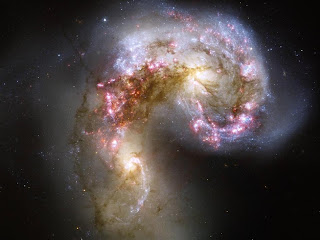
- Pity the poor astronomer whose career changed from seeing the beautiful wonders of the Cosmos, stars, galaxies, nebular, supernovae, to the biggest wonder, the “Darkness” that is 96% that he cannot see. The challenges in astronomy today are to figure out what the 24% Dark Matter and the 76% Dark Energy that occupy the darkness really are? How do we begin to understand the 96% of the Cosmos that we cannot see?
- Neither Dark Energy ,nor Dark Matter, interact with the electromagnetic energy. They do interact with gravitational energy. Dark Energy is an anti-gravity force that is expanding the space between all the matter. Dark Matter interacts with gravity in the opposite direction trying to pull matter back together. The matter that we understand because it interacts with both gravity and electromagnetism is Ordinary Matter made up of protons, neutron, and electrons. It is the 4% that we can see. The ratio of the 4% we can see to the 24% of Dark Matter that we can not see is ( 1 to 6) , ordinary visible matter to invisible Dark Matter.
- Astronomers studying galaxies and galaxy clusters find that the velocities of the stars orbiting the center are moving too fast to be held by the gravity created by the mass in the center. Galaxy’s stars should be flying off into space according to our calculations. On average there must be 6 times more gravity holding things together than we can account for as Ordinary Matter.
- Performing these calculations on the Milky Way Galaxy and the Andromeda Galaxy require the stars orbiting at the outer edges of the galaxy to be traveling much slower in order to avoid being slung into outer space. The galaxy’s outer star orbits have just as fast orbiting velocities as inner star orbits. Gravity falls off as the inverse square of distance from the central mass. Like our solar system the outer orbits have lower velocities:
------------------------------------------------ ORBITAL VELOCITIES:
------------------ Mercury -------------- 106,000 miles per hour
------------------ Venus ------------------ 78,300 miles per hour
------------------ Earth ------------------- 66,663 miles per hour
------------------ Mars ------------------- 54,000 miles per hour
------------------ Jupiter ------------------ 29,300 miles per hour
------------------ Saturn ------------------ 21,700 miles per hour
------------------ Uranus ------------------ 15,200 miles per hour
------------------ Neptune ----------------- 12,080 miles per hour
- But, in galaxies the orbital velocities are nearly the same all the way out to the edge of the disks, or spheres. To explain this there must be a halo of unseen mass surrounding the galaxy and adding at least 6 times more gravitational force holding the galaxy together. This is the Dark Matter that we do not understand. It can not be stars, it cannot be any of the 92 natural elements, it cannot be neutrinos or Blackholes. The best theory is that it is a new type of weakly interacting, massive, particle that we have yet to discover.
- Astronomers are busy measuring the mass of galaxies and comparing the ratio of visible to Dark Matter. Most galaxies in our neighborhood are ( 1 to 8 ) ratio. However, when measuring the ratio for the colliding Antenna Galaxies it is ( 1 to 4 ). Then, to add to the confusion, a nearby Dwarf Galaxy has a ratio of ( 1 to 1,000 ). This Dwarf Galaxy called Seque 1 is 75,000 lightyears away in the Constellation Leo the Lion. The galaxy is essentially a Dark Matter Galaxy. It is 1 billion times fainter than our Milky Way with the lumination equivalent to only 300 Suns yet it has the mass of 600,000 Suns.
------------- Seque 1 weighs 600,000 Solar Mass
------------- It is 400 lightyears across
------------- It is a spheroidal galaxy
------------- It is emitting light of only 300 Suns
------------- It has no Blackhole at its core
------------ It has no blocking dust or hydrogen gas clouds.
- How it can weigh 1,000 times more than the matter we can identify is a mystery. the Answer: Dark Matter is a mystery.
- Dark matter is thought to be concentrated in halos surrounding galaxies. But, it is not consistent between individual galaxies. Dark Matter does not appear to be homogeneous throughout space. The question came up, is it a consistent concentration within a Cluster of galaxies?
- Fortunately we have a way of measuring this. There is a particular cluster of galaxies 4.5 billion lightyears away that is in our direct line of sight to 12 other galaxies that are in the background. The Cluster of 100 galaxies is an enormous concentration of gravity. (named: MACS J12062). The light from the background galaxies passes by this immense gravity lens on its way to us. The light beams are bent as they pass creating multiple images from our viewpoint. 47 background images appear to our point of view. This is like holding the bottom of a wine glass up to your line of sight of a candle flame. What you see is multiple images of candle flames through the glass lens. The same concept occurs in this case and it is called “gravitational lensing“
.
- The breakthrough here is that by measuring the amount the light beams are bent astronomers can calculated the amount of gravitational force needed to cause it.
---------------- Inside a radius of 515,000 lightyears the calculated mass is 130 * 10^12 Solar Mass
--------------- Inside a radius of 312,000 lightyears the calculated mass is 80 * 10^12 Solar Mass.
------------- For comparison, our Milky Way Galaxy is 100,000 lightyears across and inside 50,000 lightyears the mass is 0.5 * 10^12 Solar Mass.
- To learn how Dark Matter is distributed inside the Galaxy Cluster the density is calculated for the two concentric volumes.
- First we calculate the density of the inside sphere.
------------------ Volume of a sphere = 4/3 *pi* radius^3
------------------- Volume = 4/3 * pi * (312,000 lightyears)^3
------------------ Volume = 1.3 * 10^17 lightyears^3
------------------ Mass = 8.0*10^13 Solar Mass
------------------ Density = Volume / Mass = 0.00062 Solar Mass / lightyears^3
- Next calculate the density between the outer sphere and the inner sphere.
------------------ Volume of a sphere = 4/3 *pi* radius^3
------------------- Volume = 4/3 * pi * (515,000 lightyears)^3
------------------ Volume = 4.4 * 10^17 lightyears^3
----------------- Mass = (13*10^13 - 8*10^13) Solar Mass
------------------ Mass between the shells = 5 * 10^13 Solar Mass
------------------ Density = 0.00011 Solar Mass / lightyears^3
- From a comparison between the density of the outer shell and the sphere around the core the density is 6 times greater near the center. Therefore, Dark Matter is not evenly distributed inside a Galaxy Cluster. It is concentrated towards the center of the Cluster. This is in contrast with individual galaxies where Dark Matter is thought to be concentrated in a halo surrounding the galaxy.
- Whatever Dark Matter is it has mass, it is influenced by gravity, it is not homogeneous throughout space, it has some structure with galaxies and clusters of galaxies yet to be understood. An announcement will be made shortly, stay tuned.
---------------------- ------------------------------------------------------------------
RSVP, please reply with a number to rate this review: #1- learned something new. #2 - Didn’t read it. #3- very interesting. #4- Send another review #___ from the index. #5- Keep em coming. #6- I forwarded copies to some friends. #7- Don‘t send me these anymore! #8- I am forwarding you some questions? Index is available with email and with requested reviews at http://jdetrick.blogspot.com/ Please send feedback, corrections, or recommended improvements to: jamesdetrick@comcast.net.
or, use: “Jim Detrick” www.facebook.com, or , www.twitter.com.
707-536-3272, Thursday, December 1, 2011
- Attachment: Dark Matter Collision, the Antenna Galaxies

- Neither Dark Energy ,nor Dark Matter, interact with the electromagnetic energy. They do interact with gravitational energy. Dark Energy is an anti-gravity force that is expanding the space between all the matter. Dark Matter interacts with gravity in the opposite direction trying to pull matter back together. The matter that we understand because it interacts with both gravity and electromagnetism is Ordinary Matter made up of protons, neutron, and electrons. It is the 4% that we can see. The ratio of the 4% we can see to the 24% of Dark Matter that we can not see is ( 1 to 6) , ordinary visible matter to invisible Dark Matter.
- Astronomers studying galaxies and galaxy clusters find that the velocities of the stars orbiting the center are moving too fast to be held by the gravity created by the mass in the center. Galaxy’s stars should be flying off into space according to our calculations. On average there must be 6 times more gravity holding things together than we can account for as Ordinary Matter.
- Performing these calculations on the Milky Way Galaxy and the Andromeda Galaxy require the stars orbiting at the outer edges of the galaxy to be traveling much slower in order to avoid being slung into outer space. The galaxy’s outer star orbits have just as fast orbiting velocities as inner star orbits. Gravity falls off as the inverse square of distance from the central mass. Like our solar system the outer orbits have lower velocities:
------------------------------------------------ ORBITAL VELOCITIES:
------------------ Mercury -------------- 106,000 miles per hour
------------------ Venus ------------------ 78,300 miles per hour
------------------ Earth ------------------- 66,663 miles per hour
------------------ Mars ------------------- 54,000 miles per hour
------------------ Jupiter ------------------ 29,300 miles per hour
------------------ Saturn ------------------ 21,700 miles per hour
------------------ Uranus ------------------ 15,200 miles per hour
------------------ Neptune ----------------- 12,080 miles per hour
- But, in galaxies the orbital velocities are nearly the same all the way out to the edge of the disks, or spheres. To explain this there must be a halo of unseen mass surrounding the galaxy and adding at least 6 times more gravitational force holding the galaxy together. This is the Dark Matter that we do not understand. It can not be stars, it cannot be any of the 92 natural elements, it cannot be neutrinos or Blackholes. The best theory is that it is a new type of weakly interacting, massive, particle that we have yet to discover.
- Astronomers are busy measuring the mass of galaxies and comparing the ratio of visible to Dark Matter. Most galaxies in our neighborhood are ( 1 to 8 ) ratio. However, when measuring the ratio for the colliding Antenna Galaxies it is ( 1 to 4 ). Then, to add to the confusion, a nearby Dwarf Galaxy has a ratio of ( 1 to 1,000 ). This Dwarf Galaxy called Seque 1 is 75,000 lightyears away in the Constellation Leo the Lion. The galaxy is essentially a Dark Matter Galaxy. It is 1 billion times fainter than our Milky Way with the lumination equivalent to only 300 Suns yet it has the mass of 600,000 Suns.
------------- Seque 1 weighs 600,000 Solar Mass
------------- It is 400 lightyears across
------------- It is a spheroidal galaxy
------------- It is emitting light of only 300 Suns
------------- It has no Blackhole at its core
------------ It has no blocking dust or hydrogen gas clouds.
- How it can weigh 1,000 times more than the matter we can identify is a mystery. the Answer: Dark Matter is a mystery.
- Dark matter is thought to be concentrated in halos surrounding galaxies. But, it is not consistent between individual galaxies. Dark Matter does not appear to be homogeneous throughout space. The question came up, is it a consistent concentration within a Cluster of galaxies?
- Fortunately we have a way of measuring this. There is a particular cluster of galaxies 4.5 billion lightyears away that is in our direct line of sight to 12 other galaxies that are in the background. The Cluster of 100 galaxies is an enormous concentration of gravity. (named: MACS J12062). The light from the background galaxies passes by this immense gravity lens on its way to us. The light beams are bent as they pass creating multiple images from our viewpoint. 47 background images appear to our point of view. This is like holding the bottom of a wine glass up to your line of sight of a candle flame. What you see is multiple images of candle flames through the glass lens. The same concept occurs in this case and it is called “gravitational lensing“
.
- The breakthrough here is that by measuring the amount the light beams are bent astronomers can calculated the amount of gravitational force needed to cause it.
---------------- Inside a radius of 515,000 lightyears the calculated mass is 130 * 10^12 Solar Mass
--------------- Inside a radius of 312,000 lightyears the calculated mass is 80 * 10^12 Solar Mass.
------------- For comparison, our Milky Way Galaxy is 100,000 lightyears across and inside 50,000 lightyears the mass is 0.5 * 10^12 Solar Mass.
- To learn how Dark Matter is distributed inside the Galaxy Cluster the density is calculated for the two concentric volumes.
- First we calculate the density of the inside sphere.
------------------ Volume of a sphere = 4/3 *pi* radius^3
------------------- Volume = 4/3 * pi * (312,000 lightyears)^3
------------------ Volume = 1.3 * 10^17 lightyears^3
------------------ Mass = 8.0*10^13 Solar Mass
------------------ Density = Volume / Mass = 0.00062 Solar Mass / lightyears^3
- Next calculate the density between the outer sphere and the inner sphere.
------------------ Volume of a sphere = 4/3 *pi* radius^3
------------------- Volume = 4/3 * pi * (515,000 lightyears)^3
------------------ Volume = 4.4 * 10^17 lightyears^3
----------------- Mass = (13*10^13 - 8*10^13) Solar Mass
------------------ Mass between the shells = 5 * 10^13 Solar Mass
------------------ Density = 0.00011 Solar Mass / lightyears^3
- From a comparison between the density of the outer shell and the sphere around the core the density is 6 times greater near the center. Therefore, Dark Matter is not evenly distributed inside a Galaxy Cluster. It is concentrated towards the center of the Cluster. This is in contrast with individual galaxies where Dark Matter is thought to be concentrated in a halo surrounding the galaxy.
- Whatever Dark Matter is it has mass, it is influenced by gravity, it is not homogeneous throughout space, it has some structure with galaxies and clusters of galaxies yet to be understood. An announcement will be made shortly, stay tuned.
---------------------- ------------------------------------------------------------------
RSVP, please reply with a number to rate this review: #1- learned something new. #2 - Didn’t read it. #3- very interesting. #4- Send another review #___ from the index. #5- Keep em coming. #6- I forwarded copies to some friends. #7- Don‘t send me these anymore! #8- I am forwarding you some questions? Index is available with email and with requested reviews at http://jdetrick.blogspot.com/ Please send feedback, corrections, or recommended improvements to: jamesdetrick@comcast.net.
or, use: “Jim Detrick” www.facebook.com, or , www.twitter.com.
707-536-3272, Thursday, December 1, 2011
Subscribe to:
Posts (Atom)