Monday, July 24, 2023

4102 - DARK STARS - did Webb just discover them?


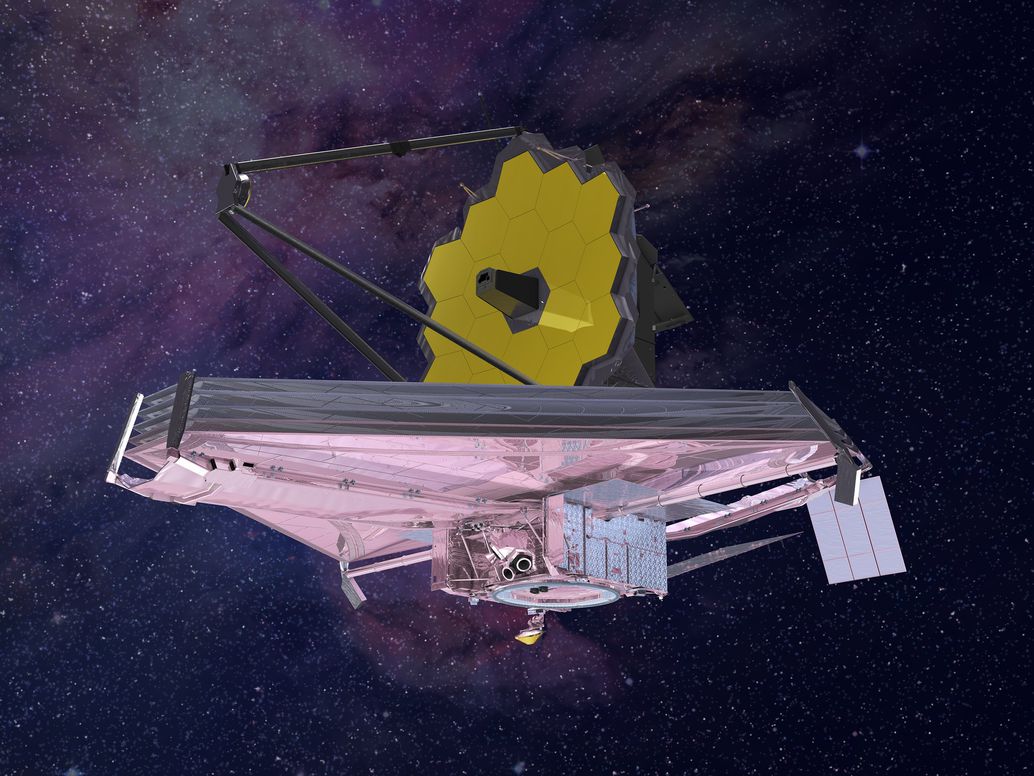
-    4102  -  DARK  STARS  -  did Webb just discover them?     Current theories about the Universe will need updating.  Webb has revealed what our universe looked like 13.5 billion years ago, when the first stars and galaxies took shape after the Big Bang.


--------------  4102  -     DARK  STARS  -  did Webb just discover them?

-    These “first light” images came from the  “Near Infrared Camera”(NIRCam) which is one of the most sensitive infrared cameras ever built.   NIRCam will serve as the primary imager aboard the Webb as it travels 1 million miles into space.

-

-    NIRCam is an infrared imager measuring wavelengths of light from 0.6 to 5 microns. It was created to detect the earliest star clusters and galaxies, as well as stars in nearby galaxies and young stars in the Milky Way and objects in the Kuiper Belt.

-

-  Webb was launched on December 25, 2021, a project nearly two decades in the making.   NIRCam is pushing the envelope of optical performance.   In addition to NIRCam, Webb has the Solar Ultra-Violet Imager and the Geostationary Lightning Mapper (GLM) for the Geostationary Operational Environmental Satellite (GOES-R).

-

-    NIRCam technology was developed to bond cryogenic optics that allow NIRCam to remain stable while functioning in ultracold temperatures: around 40 Kelvin, or about 150°F colder than the lowest temperature ever recorded in Antarctica.  

-

-   The same camera mount design has flown successfully on other missions, including NASA’s Interface Region Imaging Spectrograph (IRIS), an instrument studying how energy and plasma move near the sun’s surface. 

-

-   More projects are underway on different scales of missions and science, from programs that look at the evolution of massive stars to monitoring the Earth’s carbon cycle. Others would revolutionize vibration isolation and precision pointing for future missions, and more projects would focus on technologies designed to build smaller, lighter-weight space telescopes.

-

-    The SPIDER (Segmented Planar Imaging Detector for Electro-optical Reconnaissance) prototype is one example. It uses a thin array of tiny lenses in place of bulky mirrors or larger lenses, potentially cutting size, weight and power needs 10 to 100 times.

-

-    During the commissioning period, the telescope’s 18 gold-plated hexagonal mirrors , together totaling more than 21 feet in diameter, will unfold origami-style and its tennis-court-sized sunshield will unfurl. Then, the telescope and its elements will be cooled, aligned and calibrated.

-

-    With 18 segments, each with the ability to move in various directions or even change curvature, there are a lot of ways you can tune the mirror.  Light enters NIRCam, which uses wavefront sensing and control tools to align the mirror. 

-

-   Commissioning the telescope in space took six months.  As Webb completes its five- to 10-year mission science will be looking out for the science images NIRCam will produce.

-

-    A team of three astrophysicists analyzed images from the James Webb Space Telescope (JWST) and found three bright objects that might be “dark stars,” theoretical objects much bigger and brighter than our sun, powered by particles of dark matter annihilating. If confirmed, dark stars could reveal the nature of dark matter, one of the deepest unsolved problems in all of physics.

-

-    Although dark matter makes up about 25% of the universe, its nature has eluded scientists. Scientists believe it consists of a new type of elementary particle, and the hunt to detect such particles is on.

-

-     Among the leading candidates are “Weakly Interacting Massive Particles”. When they collide, these particles annihilate themselves, depositing heat into collapsing clouds of hydrogen and converting them into brightly shining dark stars. The identification of supermassive dark stars would open up the possibility of learning about the dark matter based on these observed properties.

-

-    The objects’ spectroscopic properties, including dips or excess of light intensity in certain frequency bands, could help confirm whether these candidate objects are indeed dark stars.  Confirming the existence of dark stars might also help solve a problem created by JWST that is there seems to be too many large galaxies too early in the universe to fit the predictions of the standard model of cosmology.

-

-    The three candidate dark stars (JADES-GS-z13-0, JADES-GS-z12-0, and JADES-GS-z11-0) were originally identified as galaxies in December, 2022,  by the JWST Advanced Deep Extragalactic Survey (JADES). Using spectroscopic analysis, the JADES team confirmed the objects were observed at times ranging from about 320 million to 400 million years after the Big Bang, making them some of the earliest objects ever seen.

-

-    “Dark stars” could theoretically grow to be several million times the mass of our sun and up to 10 billion times as bright as the sun.  JWST has found three supermassive dark star candidates.

-

-     At the centers of early protogalaxies, there would be very dense clumps of dark matter, along with clouds of hydrogen and helium gas. As the gas cooled, it would collapse and pull in dark matter along with it. As the density increased, the dark matter particles would increasingly annihilate, adding more and more heat, which would prevent the gas from collapsing all the way down to a dense enough core to support fusion as in an ordinary star.

-

-     Instead, it would continue to gather more gas and dark matter, becoming big, puffy and much brighter than ordinary stars. Unlike ordinary stars, the power source would be evenly spread out, rather than concentrated in the core. With enough dark matter, dark stars could grow to be several million times the mass of our sun and up to 10 billion times as bright as the sun.

-

-

July 23,  2023     DARK  STARS  -  did Webb just discover them?                 4102

------------------------------------------------------------------------------------------                                                                                                                        

--------  Comments appreciated and Pass it on to whomever is interested. ---

---   Some reviews are at:  --------------     http://jdetrick.blogspot.com ----- 

--  email feedback, corrections, request for copies or Index of all reviews

---  to:  ------    jamesdetrick@comcast.net  ------  “Jim Detrick”  -----------

--------------------- ---  Monday, July 24, 2023  ---------------------------------


4101 - LIFE ON MARS?


-    4101  -   LIFE  ON  MARS?  -    The search for life on Mars has been a long a confusing one. Inconclusive experiments abound, but one thing is certain, there is definitely “organic” material on the Red Planet.


--------------  4101  -    LIFE  ON  MARS?   

-    “Viking”, one of the early landers on the Red Planet back in the 1970s, had an experimental result that puzzled scientists at the time.  A few chemicals made it look like the sensor had been contaminated with cleaning fluids. It wasn’t until decades later, in 2008, that the Phoenix lander found “perchlorate” in the Martian regolith that it became clear that the Viking lander hadn’t detected cleaning materials.  It had seen organic material that had been reacting with perchlorate in its sample.

-

-    “Phoenix” also directly measured organics in the Martian soil, notably methane, one of Earth’s most common organic materials. “Curiosity” also contributed with a clear detection of organics in 2012. But more recently, another, more capable rover arrived on the scene.

-

-    “Perseverance” landed on Mars in 2021 and has served as the basis for much of the ongoing burst of research about the planet.  “SHERLOC” , the name of the research instrument,  scans a target from about 2 inches away using techniques, deep ultraviolet Raman and fluorescence spectroscopy, which can help differentiate types of organic materials in the object being scanned

-

-    Signs appeared in SHERLOC’s data that were “consistent with molecules linked to aqueous processes”.    Some organic materials that SHERLOC collected data on were created underwater.

-

-   That might not come as a big surprise, given that Jezero Crater, Perseverance’s landing spot, was specifically selected as it was thought to be a dried-up lake bed.

-

-    This does not mean that Martian life created these organic compounds. Plenty of geochemical processes can do so, and the general consensus of Perseverance’s scientific teams is that all the organic signatures they have seen so far can be attributed to creation by non-biological processes.

-

-    But, we are just now scratching the surface of the organic carbon story on Mars. Despite 50 years of data collection, most of that story still needs to be written. And, despite some recent setbacks in the development of the Mars Sample Return, Perseverance’s follow-up mission, there will be plenty of other opportunities to study these compounds on the Red Planet in the future.

-

-

July 22,  2023                      4101

------------------------------------------------------------------------------------------                                                                                                                       

--------  Comments appreciated and Pass it on to whomever is interested. ---

---   Some reviews are at:  --------------     http://jdetrick.blogspot.com ----- 

--  email feedback, corrections, request for copies or Index of all reviews

---  to:  ------    jamesdetrick@comcast.net  ------  “Jim Detrick”  -----------

--------------------- ---  Monday, July 24, 2023  ---------------------------------


Saturday, July 22, 2023

4100 - WEBB TELESCOPE - sees most distant galaxy?


-    4100  -   WEBB TELESCOPE  -  sees most distant galaxy?      As astronomers push our views of the Universe further back in time, their telescopes keep uncovering surprises. That’s the case with a supermassive black hole in CEERS 1019, a distant very early galaxy.


--------------  4100  -   WEBB TELESCOPE  -  sees most distant galaxy? 

-    CEERS 1019 galaxy already existed and was assembling itself some 570 million years after the Big Bang. The James Webb Space Telescope (JWST) caught a glimpse of it and studied its black hole. It also took data about two other black holes as they were when the Universe was about a billion years old.

-

-    These galaxy and black hole discoveries are part of a special observing program, called the “Cosmic Evolution Early Release Science” (CEERS) Survey. The idea is to get detailed images and spectra of early, distant objects in infrared and mid-infrared light.

-

-    Objects in the very early universe shine in ultraviolet and visible light. However, by the time their light reaches us, it’s “stretched” into the infrared region. Since infrared also can penetrate through dusty regions, it gives the added advantage of seeing objects that otherwise would be hidden by the dust.

-

-    Finding black holes in the early universe in early galaxies opens up our understanding of that time in cosmic history. It is shortly after the Big Bang.  This newly found CEERS galaxy and its active supermassive black hole surprised astronomers.

-

-    CEERS 1019 existed at a time when the first galaxies were forming. So, they should be small and relatively featureless.   And, if they have black holes at that early epoch, those should be relatively low-mass?

-

-   It turns out that those black holes are lower-mass. But, at least one of them is still larger than it should be. How do we know this? JWST can study both early galaxies and their black holes.    Not only can we see black holes and galaxies at extreme distances, we can now start to accurately measure them.

-

-    The black hole, within galaxy CEERS 1019, existed just over 570 million years after the big bang and is far less massive than other black holes previously found in the early universe.

-

-   The galaxy itself appears as three bright clumps without a disk. So, it’s really still assembling itself and cranking out new stars as it builds its structure. A galaxy merger could be partly responsible for fueling the activity in this galaxy’s black hole, and that could also lead to increased star formation.

-

-    The infant supermassive black hole is ingesting gas and turns out to have 9 million solar masses. That’s less than some black holes of its era but still larger than expected. It exists so early in history that it seems to have formed very shortly after the Universe began.

-

-    The black hole turns out to be more like Sagittarius A*, the one in the center of the Milky Way.   While the infrared view shows us the structure of the galaxy, the spectral lines reveal other characteristics.  Spectra can pinpoint high-energy outflow speeds and temperatures.

-

-     The spectroscope captures both the black hole and its host galaxy. Its data reveal the black hole’s appetite for gas as well as the star-formation rate.   These first discoveries are priming astronomers to refine their ideas about black holes and galaxy formation in the infant universe.

-

-    The “epoch of reionization” was when light from the first stars could travel through the infant universe. At this time, galaxies began assembling, as did black holes.

The epoch of reionization was when light from the first stars could travel through the infant universe. At this time, galaxies began assembling, as did black holes.

-

-    CEERS focuses on these objects as they existed in the Epoch of Reionization, a point in cosmic history when light began to travel freely across the expanding universe. That light came from the first stars and ionized the gas between stars and galaxies.

-

-    Galaxies began assembling during this time (and perhaps earlier) as well. The survey data covers the build-up of stars stellar mass, the morphological changes in the galaxies as a result, as well as the growth of those early black holes.

-

-    This period is key to tracing a timeline of the Universe’s origins and evolution through the buildup and transformation of those earliest galaxies. This is one of the key aims of the JWST, which is just finishing its first full year of observing the infrared universe, July, 2023.

-

July 20,  2023            WEBB TELESCOPE  -  sees most distant galaxy?             4100

------------------------------------------------------------------------------------------                                                                                                                       

--------  Comments appreciated and Pass it on to whomever is interested. ---

---   Some reviews are at:  --------------     http://jdetrick.blogspot.com ----- 

--  email feedback, corrections, request for copies or Index of all reviews

---  to:  ------    jamesdetrick@comcast.net  ------  “Jim Detrick”  -----------

--------------------- ---  Saturday, July 22, 2023  ---------------------------------


Friday, July 21, 2023

4100- Index of Reviews 4050 to 4100


            -  4100  -   Index of Reviews 4050 to 4100

            -     This index is of the 50 reviews from 4050  to 4100.  Indices of all previous reviews is available upon request.      Writing style is stochatto with each paragraph an idea and limited to a few pages in total.  Comments are always welcome.  See https:://jimdetrick@blogspot.net

             ----------------------------------------------------------------------------


            ------------------  4100-  Index of Reviews 4050 to 4100


            -     4050  -   ELEMENTS  -  Periodic Table of chemistry?      There are 92 natural elements. These are those elements listed in the Periodic Table for Chemistry.  We know the heavier elements above hydrogen ( 1 proton) and helium ( 2 protons) are produced in the explosions of stars, called supernovae.  Hydrogen and helium were produced in the Big Bang

            -

            -    4051  -  DARK  MATTER  -   what simulations tell us?    Dark Energy is the mysterious force that is expanding the Universe causing all matter not held by greavity to accelerate apart.  Dark matter is the invisible material that makes up the vast majority of the universe's mass, it may collect itself to form atoms.

            -

            -    4052  -  EFFIC IENT  ENEREGY   -   the better solution?  Everyone participating in energy efficiency is the fastest way and cheapest way to achieve our energy needs over the next 50 years. 

            -

            -    4053  -  DARK  ENERGY   -  Why is it expanding the Universe?     Most astronomical data we have today confirms the fact (theory in fact) that the Universe is still expanding at an ever increasing rate.  The cause is suspected to be some type of anti-gravity that is named “ Dark Energy”.    We know what gravity is and we expected gravity to eventually stop the expansion and reverse the Universe into a “ Big Crunch”.

            -

            -    4054  -   COSMIC  MICROWAVE  BACKGROUND  ?      The sixth wonder of the Universe is the Cosmic Background Radiation.  It is everywhere, filling the entire Universe, in all places and in all directions.  You can see it as snow on your UHF TV by tuning the receiver between stations.

            -

            -    4055  -  GAMMA  RAY  BURSTS  -  what is the largest?     What was the brightest cosmic explosion of all time?  A jet of particles pierces a star as it collapses into a black hole during a typical gamma-ray burst.   This jet was created by gamma-ray burst 221009A.

            -

            -    4056  -  UNIVERSE  -  is it a  blackhole?  Is it collapsing into one?  The expansion of the universe in its early days prevented all the matter from collapsing.   If our universe was born with way too much matter it could have slowed down that expansion. But the fact is that there wasn't enough matter to do so, and the expansion of the universe was able to dilute the material of the cosmos enough so that it could never collapse again.

            - 

            -     4057  -   EARLIEST  GALAXIES  -   was this the beginning?   The James Webb Telescope (JWST or Webb) has unveiled hundreds of ancient galaxies that could be among the first members of the universe.  As early as 600 million years after the Big Bang, these very young galaxies had complex structures and clusters of star formation.

            -

            -    4058  -   NUCLEAR FORCES  -  to undertand atoms?    To test the strong nuclear force, physicists turned to the helium-4 nucleus, which has two protons and two neutrons. When helium nuclei are excited, they grow like an inflating balloon until one of the protons pops off.

            -

            -    4060  -  MARS  -  the forth planet from the Sun?    The Red Planet is a cold, desert world within our solar system. It has a very thin atmosphere, but the dusty, lifeless planet is far from dull.  Here are some new discoveries in space exploration.

            -

            -    4061  -    DARK  SKIES -   why is it not filled with starlight?    When we look at dark skies we see all those stars sending us their light.  Why does all that light not fill up the sky like our Sun?  I know they are far away but all that light should eventuall reach us. 

            -

            -      4062 -   MOON  -   and Earth's rotation?   In the prehistoric past, Earth may have been stuck with 19-hour days for a billion years  and the moon was to blame.  Between 2 billion and 1 billion years ago, a full day lasted five hours less than it does now because of how close the moon lingered near Earth.

            -

            -     4063  -   GENERAL  RELATIVITY  - new ways to test?      The theory of general relativity (GR), proposed by Einstein over a century ago, remains one of the most well-known scientific postulates of all time. This theory, which explains how spacetime curvature is altered in the presence of massive objects, remains the cornerstone of our most widely-accepted cosmological models.

            -

            -     4064  -   GALAXIES  -  are blackholes at the centers?     The theory of general relativity (GR) remains one of the most well-known scientific postulates of all time. This theory, which explains how spacetime curvature is altered in the presence of massive objects, remains the cornerstone of our most widely-accepted cosmological models.

            -

            -

            -     4065  -  EARLIEST  STARS-  may have been discovered?   JWST may have succeeded in one of the biggest goals in the entire field of astrophysics. If this is eventually confirmed as the first true detection of a “Population III star”, it unlocks a whole new universe of scientific exploration and discovery.

            -

            -    4066  -  GAMMA  RAY  BURSTS  -  how first discovered?     On June 1, 1973, astronomers around the world were introduced to a powerful and perplexing new phenomenon called GRBs (gamma-ray bursts). Today sensors on orbiting satellites like NASA's Swift and Fermi missions detect a GRB somewhere in the sky about once a day on average. Astronomers think the bursts arise from catastrophic occurrences involving stars in distant galaxies, events thought to produce new black holes.

            -

            -    4067  -  GAMMA  RAY  BURSTS  -   how to explain them?    Fifty years ago, on June 1, 1973, astronomers around the world were introduced to a powerful and perplexing new phenomenon called GRBs (gamma-ray bursts). Today sensors on orbiting satellites like NASA's Swift and Fermi missions detect a GRB somewhere in the sky about once a day on average. Astronomers think the bursts arise from catastrophic occurrences involving stars in distant galaxies, events thought to produce new black holes.

            -

            -      4068  -   EARTH'S  ORBIT  -  and salty seas?   Nearly 10,000 years ago, Earth came out of its most recent ice age. Vast, icy swaths of land around the poles thawed, melting the glaciers that had covered them for nearly 100,000 years.   Why, after such a long period of cold, did the ice age finally come to an end?

            -

            -     4069  -    MYSTERIES  IN  ASTRONOMY?     ASTRONOMY  -  mysteries.  No physicist would dare assert that our physical knowledge of the universe is near completion. To the contrary, each new discovery seems to unlock a Pandora's box of even bigger, even deeper physics questions.  Here are some astronomical mysteries.

            -

            -     4070  -  EUCLID  SPACE  TELESCOPE  -  observing the expansion of the Universe.  5 billion years after the Big Bang, the dynamics of the universe changed: instead of slowing down further, the expansion of the universe is still accelerating today. This “dark energy” now dominates the expansion.

            -

            -     4071  -  NEUTRINOS  -  discovered by IceCube Observatory.     The first 'ghost particle' image of Milky Way galaxy are neutrinos detected by IceCube.    Our Milky Way galaxy is an awe-inspiring feature of the night sky, viewable with the naked eye as a horizon-to-horizon hazy band of stars. Now, for the first time, the IceCube Neutrino Observatory has produced an image of the Milky Way using “neutrinos”, tiny, ghostlike astronomical messengers, but not photons.

            -

            -     4072  -  UNIVERSE  -  new theories for space-time?     The Cosmological models we are using today are built on a simple, century-old idea, but new observations demand a radical rethink.   Our ideas about the universe are based on a century-old simplification known as the cosmological principle. It suggests that when averaged on large scales, the Cosmos is homogeneous and matter is distributed evenly throughout.

            -

            -     4073  -    GRAVITY  WAVES  -  detected using Pulsars?       Scientists have been hunting for the gravitational wave background, a faint but persistent echo of gravitational waves thought to have been set off by events that took place soon after the Big Bang and the mergers of supermassive black holes throughout the universe.

            -

            -     4074  -   NEW  SPACE  TELESCOPES  -      Depending on what they find, Roman and Euclid telescopes could confirm that General Relativity and the predominant model of the cosmos, the Lambda Cold Dark Matter (LCDM) model, is correct. On the other hand, they could verify that our models need revision and point the way toward a grand resolution.

            -

            -    4075  -    SUMMER  SOLTICE  -  and more mysteries?    The mid-year solstice in 2023 falls on 21 June..  Depending on where you are, this will either be your winter solstice (for those in the southern hemisphere) or the summer solstice (for our northern hemisphere).

            -

            -     4076  -     MILKY WAY  GALAXY  -  learn about your home?     How  can we see our Galaxy while living inside it?    All the stars we see is the Milky Way Galaxy, but, the milky path across the sky is what gives it its name.  The Milky Way is what we see looking at our galaxy edge-wise.

            -

            -     4077  -   MILKYWAY  GALAXY  -  from the inside out?     The more galaxies you observe the more you realize that galaxies are like snowflakes, no two are alike. Astronomers are surmising more every day what our galaxy looks like from the inside out.

            -

            -     4078  -   SPACE TIME  -  was Einstein right?     Distortions in space-time could put Einstein's theory of relativity to the ultimate test.  Observing time distortions could show whether Einstein's theory of general relativity accounts for the mysteries of dark matter and dark energy.

            -

            -     4079  -    OLDEST  GALAXIES  -  ever detected?    James Webb telescope detects the earliest strand in the 'cosmic web' ever seen.  The Space Telescope has discovered a clump of ancient galaxies that may be the oldest strand of the "cosmic web" ever detected.

            -

            -    4080  -   OLDEST  GALAXY  -  discovered by James Webb.    A distant swirling galaxy imaged by the powerful space telescope may look serene but it has a violent past.   The serene-looking orange-red galaxy is a cosmic spiral of gas, dust, and stars that hides a violent past representing the wreckage of a massive collision between two earlier galaxies that proceeded around 500 million years ago.

            -

            -    4081  -  EARTH  MYSTERIES   -  why are we all wet?    When the first Earth Day was held in 1970, geologists were still putting the finishing touches on plate tectonics, the model that explains how the Earth's surface takes shape. More than 40 years later, many riddles still remain when it comes to our planet.

            -

            -    4082  -   “EUCLID'S”  -  space mission, 2023?     July 1st, 2023 the ESA’s Euclid space telescope lifted off from Cape Canaveral in Florida. This next-generation astrophysics mission will spend the next few weeks flying to the Earth-Sun L2 Lagrange Point, where it will spend the next six years observing one-third of the sky.

            -

            -     4083  -  GRAVITATIONAL  LENSING  -   measures galaxy mass?   Gravitational lensing events are very rare, with one galaxy in a thousand unveiling the phenomenon. Since quasars are seen in about one every thousand galaxies a quasar acting as a lens is one in a million. The scientists expect to detect hundreds of these lensing quasars with the ESA-NASA mission Euclid, to be launched this summer with a Falcon-9 SpaceX rocket.

            -

            -    4084  -  JAMES  WEBB  -  2023 planned explorations .    The James Webb Space Telescope (JWST) has accomplished some amazing things during its first year of operations!  Webb completed its first deep field campaign, turned its infrared optics on Mars and Jupiter, obtained spectra directly from an exoplanet’s atmosphere, blocked out the light of a star to reveal the debris disk orbiting it, detected its first exoplanet, and spotted some of the earliest galaxies in the Universe that existed at Cosmic Dawn

            -

            -    4085  -   BETELGUESE  -  brightest ready to explode?      One of the brightest stars in the night sky might die in a spectacular explosion within our lifetime. The conjecture is that the red giant star Betelgeuse, the left shoulder of the constellation Orion also known as Alpha Orionis, may have less than three hundred years' worth of fuel left in its core.

            -

            -    4086  -   UNIVERSE  TIME  -  ran slower in the beginning?   Time moved '5 times slower' in the early universe, a mind-bending black hole study reveals. This observation that the universe appears to run slower in the past was made by scrutinizing the light emitted by gigantic quasars.

            -

            -    4087  -   DESI  -  new astronomical discoveries?      DESI collects spectra, the different frequencies of l-ight that objects in space emit. That light tells researchers how far away the object is, meaning they can create a 3D map of the universe.

            -

            -    4088  - OLDEST  BLACKHOLE -  James Webb telescope discovers the oldest active black hole in the known universe.   Astronomers have discovered a feeding supermassive black hole from when the universe was less than 600 million years old.

            -

            -    4089  -  NEUTRON  STARS  -  new Webb discoveries?     The James Webb telescope traced an incredibly bright gamma-ray burst to a kilonova, a dramatic event believed to forge heavy elements like gold.  This incredibly bright gamma-ray burst (GRB) was traced back to its source, a violent collision between two neutron stars.

            -

            -    4090  -  COSMIC  MICROWAVE  BACKGROUND  -  13.6B years old?     Astronomers have a new kind of telescope called the “Murchison Wide-Field Array” installed in the remote desert of Western Australia.  Potentially this telescope could look further back in time than the Cosmic Microwave Background, which is at 370,000 years after the Big Bang.

            -

            -     4091  -    UNIVERSE  -  What is the universe made of?  Beyond the “Standard-Model theories” have not yet successfully predicted any new experimental phenomenon or any experimental discrepancy.  After five decades, far from requiring an upgrade, the Standard Model is worthy of celebration as the Absolutely Amazing “Theory of Almost Everything”.

            -

            -     4092  -    COSMIC RAYS and GAMMA RAYS?   Cosmic Rays and Gamma Rays are high energy phenomena that are amazing things to study.  They represent some of the extremes of the Universe.  Cosmic Rays are not rays at all.  They are actually sub-atomic particles, usually the nuclei or hydrogen or helium atoms.  They obtain their high energy by traveling so fast, often near the speed of light.

            -

            -     4093  -    ICE  AGE  -    what caused it?       What caused the last ice age to end around 10,000 years ago?  Nearly 10,000 years ago, Earth came out of its most recent ice age. Vast, icy swaths of land around the poles thawed, melting the glaciers that had covered them for nearly 100,000 years.

            -

            -     4094  -  MESONS  -  part of the family of particles?     Mesons are brick layers.  They work with stones.  Right?  Wrong, that is masons. Mesons is not even in Webster’s dictionary.  You need a science dictionary.  Mesons are sub-atomic particles.  Mesons are not in our every day world, but they are important for physicists to understand how our world got to where it is.

            -

            -    4095  -    STARS  -  determining their ages?   How old are the stars?  Well, they are all different ages from just born to just dying at 13 billion years old.  Our Sun is 4.6 billion years old and will not die until it is 10 billion years old.

            -

            -    4096  -    EARLIEST  GALAXIES  -  more than expected?     As astronomers push our views of the Universe further back in time, their telescopes keep uncovering surprises.

            -

            -     4097  -   LIGHT  -  how fast does it travel?   Light travels vast but space has enormous distances.  By the way Andromeda Galaxy is the farthest thing you can see with the naked eye.  Check it out. It too 2.5 million years to reach your eyes.

            -

            -   4098  -  PLANETARY  NEBULAE  -  at center of Milkyway?    Astronomers know a great deal about planetary nebulas, but an arrangement of such clouds in the galactic bulge at the center of our Milky Way galaxy has still been a puzzle since its discovery 10 years ago, 2013.  

            -

            -     4099  -  MILKYWAY  GALAXY   -  gas clouds at the center?    A mysterious alignment of stellar "ghosts" from dead stars haunts the heart of the Milky Way. They exist in the form of planetary nebulas, clouds of gas that are expelled by dying stars at the end of their lives. These can resemble butterflies or hourglasses with the smoldering remains of the star at their heart.

            -

            -     4100  -   WEBB TELESCOPE  -  sees most distant galaxy?      As astronomers push our views of the Universe further back in time, their telescopes keep uncovering surprises. That’s the case with a supermassive black hole in CEERS 1019, a distant very early galaxy.

            -

            -

            June 13,2023        Index of Reviews 4050 to 4100                          4050                                                                                                                           

            ----------------------------------------------------------------------------------------

            -----  Comments appreciated and Pass it on to whomever is interested. ---

            ---   Some reviews are at:  --------------     http://jdetrick.blogspot.com ----- 

            --  email feedback, corrections, request for copies or Index of all reviews

            ---  to:  ------    jamesdetrick@comcast.net  ------  “Jim Detrick”  -----------

            --------------------- ---  Friday, July 21, 2023  ---------------------------