Thursday, November 15, 2012

From Bubble Nebula to rocky planets - Calculus

-
--------------------- #1514 - From Bubble Nebula to Rocky Planets
-
- Nebula are astronomy’s beautiful images. Google the “Bubble Nebula” for a great example. These are stellar nurseries where suns and planets are forming. Use calculus to calculate how fast a planet forms in the accretion disk of a new born star inside one of these nurseries.
-
- The Bubble Nebula is located in the Constellation Cassiopeia the Queen. Cassiopeia is the “lazy w” of stars located in the opposite side of the night sky’s Northern Star from the Big Dipper. The south-west arm in the winter shy’s lazy “w” points to the Bubble Nebula (NGC7635).
-
- The Bubble Nebula was first discovered in 1787 by William Herschel. He is the astronomer that discovered the planet Uranus in 1781. He was using a 6 inch telescope in his backyard.
-
- Today the Nebula is classified as an emission nebula with 3 distinct expanding shells. What is visible as the “ Bubble” is the smallest of these shells. There is a massive star at the center of the Bubble emitting powerful ultraviolet light. The UV radiation is stripping away the electrons from the atoms in the interstellar medium. This ionization creates free electrons and positive ion nuclei.
-
- When the atomic nuclei recapture the electrons their energy level falls and energy is released as photons of visible light. These light photons cause the expanding gas cloud to glow like a neon sign. Our Sun will have a similar fate as a “ planetary nebula” when it dies in 5 billion years from now. The Bubble’s star is 40 times more massive than our Sun. It has a shorter lifetime because it creates a massive stellar wind blowing outward at 4,000,000 miles per hour.
-
- The Bubble has been pushed out to 10 lightyears diameter. It is 7,100 lightyears away. A similar show of ionized atomic hydrogen can be seen in the Orion Nebula (M42) See Review #1509.
-
- The temperature inside the cloud where the stars and planets are forming is only 10 Kelvin (-442 degrees Fahrenheit). Electrostatic forces gather the cloud and gravity collapse it into clumps. The clumps collapse further into protostars. When densities and temperatures reach high enough level the star turns on with nuclear fusion.
-
- These stars are typically massive stars 15 to 30 Solar Mass. Their Solar Winds expand in an irregular fashion as they smash into different densities of the interstellar medium. Over 5,000 of these space bubbles have been found in our Milky Way Galaxy. Google the Bubble Nebula to see an example of what our neighborhood was like 5 billion years ago.
-
- The young stars have rotating accretion disks that are forming planets, asteroids and comets. How long does it take a planet the size of Earth to form? With some math and some assumptions we can make a first approximation. The answer is about ¾ of a million years for an Earth-size planet to form. Here is how the math works:
-
------------------- The planet is a sphere, and the volume of a sphere is V = 4/3 *pi *r^3
------------------ The density of the Earth is D = 3,000 kilograms / meter^3
------------------ The mass of the Earth is M = 5.9*10^24 kilograms.
------------------- Mass = Volume * Density
------------------- M = V * D
------------------- M = 4/3* pi * r^3 * D
-
- To express the change of mass as a function of time, we can use the change in radius as a function of time. The goal here is to see how fast the mass can accumulate in the accretion disk in order to form a planet. We use calculus that integrates collapsing sperical areas of the disk until the core reaches the density of the final Earth-size planet.
-
---------------- M (t) = 4/3 * pi* r(t)^3 * D
-
- Solving this equation to get the radius as a function of time.
-
---------------- r(t) = ( 3M) / 4*pi*D) ^ 1/3
-
- Next we need an expression for the rate of change of mass due to the collapsing accretion disk. Each shell is an area and these areas are adding up as they collapse and the radius gets smaller and smaller. Here is the rate of change of mass due to the change of radius with time.
-
------------------------- dM / dt = 4*pi* [r (t)]^2 * (d * v)
-
- In this case the lower case “ d” is the density of the accretion disk of in-falling material.
-
------------------------ d = 0.000001 kilograms / meter^3
-
- The velocity of the in-falling material is “v” = 2,200 miles per hour, ( 1,000 meters / second)
-
------------------------ v = 1,000 meters / second
-
--------------------- The velocity times the density = (v *d) = 10^3 meters / sec * 10^-6 kilograms / meter^3 = 10^-3 meters^2 * kilogram* second.
-
---------------------- (v * d) = 10^-3 meters^2 * kilogram* seconds
-
- Remember our goal is to determine the “time” it takes to form the planet. We use the expression for the rate of change of mass with time as a function of collapsing radius:
-
------------------------- dM / dt = 4*pi* [r (t)]^2 * (d * v)
-
- And, substitute the expression for radius as a function of time
-
----------------------------- r(t) = [ 3M / 4*pi*D) ^ 1/3]
-
-------------- dM / dt = 4*pi* [ 3M / 4*pi*D) ^ 2/3]* (d * v)
-
- Moving mass as a constant out of the equation:
-
--------------- dM / dt = 4*pi* [( 3 / 4*pi*D) ^ 2/3]* (d * v) * M^2/3
-
- Dividing each side by M^2/3 and expressing change in mass as a function of time:
-
---------------- dM /M^2/3 = 4*pi* ( 3 / 4*pi*D) ^ 2/3* (d * v) dt
-
- We integrate both sides of this differential equation to find an expression for the mass as a function of time.
-
----------------- 3 M^1/3 = 4*pi* ( 3 / 4*pi*D) ^ 2/3* (d * v) * t
-
------------------ M = ( 4 *pi* d * v / 3)^3 * ( 3 / 4*pi*D) ^ 2 * t^3
-
- Substituting the values in for mass and densities, then solving for time”
-
------------------- 5.9*10^24 = ( 4.19 * 10^-3 )^3 * ( 0.239 / 3000) ^ 2 * t^3
-
-------------------- 5.9*10^24 = ( 73.6*10^-9 ) * ( 6.33*10^-9) * t^3
-
-------------------- 5.9*10^24 / 4.66 * 10^-16 = t^3
-
------------------- t^3 = 1.27 * 10^40 seconds
-
------------------- t = 2.33 *10^13
-
- There are 31,600,000 seconds in one year:
-
-------------------- t = 2.33*10^13 sec / 3.16*10^7 sec/year
-
-------------------- t = 738,000 years
- The time it takes for an Earth -size planet to from is about ¾ million years.

Tuesday, November 13, 2012

Getting familiar with the Standard Model of Particle Physics

-
--------------------- #1512 - Getting Familiar with the Standard Model
-
- The Standard Model of Particle Physics has 34 fundamental particles defined that are the total composition of the Universe. Everything from soup to nuts in the Universe is made of this stuff. 17 of these are “matter particles” and 17 are “Anti-matter particles“. The Anti-matter particles are exactly the same matter particles except the Anti-matter particles have the opposite charge.
-
- Anti-matter does not occur often in our natural world. The “ natural world” we are familiar with has only 17 matter particles. But, 5 of these 17 are force carriers that create force fields that are responsible for the 4 forces:
-
------------------------------ FORCE ---------------------- PARTICLE
-
------------------------ electromagnetic force ------------ photon
------------------------ strong nuclear force ------------- gluon
----------------------- weak nuclear force --------------- W and Z bosons
----------------------- Higgs Field that creates mass --- Higgs boson
-
----------------------- Gravity is not included in the Standard Model but it has its own force field and force carrier yet to be discovered. The undiscovered particle is named the “ graviton”.
-
- Of these 17 particles only two are massless, the photon and the gluon. Massless particles only move at one speed, the speed of light.
-
- The particles that are force carriers are called “bosons“. The remaining 12 particles are called “fermions“.
-
- 6 of these 12 particles are called “Quarks“. The 2 Quarks that are in our natural world, since they are at their lowest energy level, are the Up-Quark and the Down-Quark. These make up all the protons and neutrons that exist in the nucleus of atoms. The other 4 Quarks exist at higher energy levels and quickly decay to the lower energy levels. They are called Charm and Strange Quarks, and, Top and Bottom Quarks.
-
- The other 6 of these 12 particles are called “Leptons“. The 2 that make up our natural world are the electron and the neutrino. The other 4 particles again exist at higher energy levels and decay back to the lowest energy level as soon as they can. The higher energy electrons are called Muons and Tau’s. The 3 neutrinos are called Electron Neutrino, Muon Neutrino and Tau Neutrino. All three neutrinos are nearly massless.
-
- So, if you just look at the lowest energy level natural world, our entire “ universe” is made up of only 3 particles of matter ( Fermions) and 5 particles of force carriers (Bosons). The 3 matter particles are the electron, Up-quark and Down-quark. The 5 force carries are photons, gluons, W-bosons, Z-bosons, and Higgs bosons.
-
- The last of these particles to be discovered is the Higgs Boson. It is very massive itself at 125 million electron volts / c^2. This particle creates the Higgs Field. When fundamental particles interact with the Higgs Field they acquire the property of inertia or mass.
-
- The Higgs Field is somewhat analogous to the electric field. The fundamental particle to create this field is the photon. The electron has the electric charge and the photon is the force carrier to cause other like charges to repel and unlike charges to attract. The photon is a boson that carries the electromagnetic force.
-
- We call all 17 of these particles “ fundamental”, but they may not be. They too may be made up of smaller more fundamental particles. See Review #1502 for a discussion about “ Preons”.
-
- Some investigations are underway to decide if the electron is a fundamental particle, or, is it too made up of smaller particles?
-
- One way to decide if smaller particles exist inside the electron is to measure the “spin” and magnetic moment very precisely. The electron has quantum spin of ½. Quantum means it has two distinct spins, either quantum spin-up +½, or, quantum spin-down - ½.
-
- Because the electron is electrically charged if it is spinning it creates a magnetic moment. It has a north and south pole likes a permanent magnet.
-
- Add energy to an electron creates a heavier particle called a “Muon“. adding more energy still creates a still heavier particle called a “Tau”. The three particles together are called “ Leptons”.
-
- If an electron is fundamental, point-like, and not made up of smaller particles, it should have a single, and specific magnetic moment. If measurements of the electron and muon magnetic moments are able to find magnetic moments that differ from prediction, that result would strongly suggest that these particles are not point-like and are actually made up of still smaller particles.
-
- Do Quarks and Leptons have a non-zero size? Do Quarks and Leptons, together called Baryons have symmetry? How about Matter and Anti-matter is there equal amounts of both?
-
- Experiments to date show that the symmetry ratio of (Matter - Anti-matter) // (Matter + Anti-matter) must be less than 10^-10. The ratio of the difference over the sum is exceedingly small. Somehow, someway, there must be an excess of matter over Anti-matter or we would not be here to question it.
-
- If an electron and an Anti-electron are brought together they annihilate each other in 100% electromagnetic radiation, Gamma Ray energy. E = mc^2, Energy = 90,000,000,000,000,000 * mass. Mass is just a lot of energy. Mass can turn into energy and energy can turn into mass.
-
- If a proton and an Anti-proton are smashed together they annihilate each other into a mess of particles as well as energy. Protons are not fundamental, they are made up of Quarks. The proton is one Down-Quark and two Up-Quarks held together by Gluons, the force carrier for the Strong Nuclear Force.
-
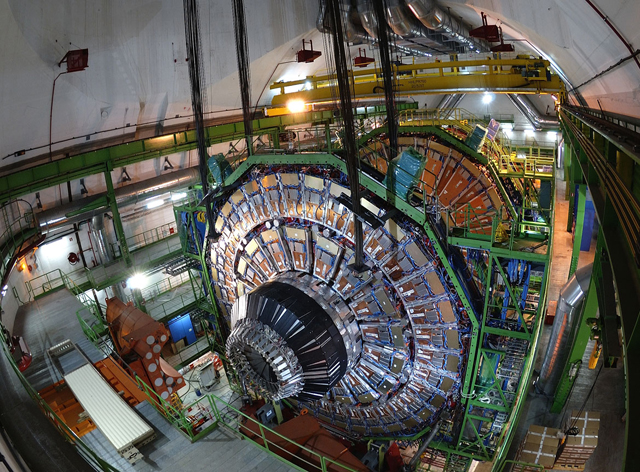
- The Anti-proton is one Down-Anti-Quark and two Up-Anti-Quarks. When protons and Anti-protons are smashed together you get a mess of particles. Physicists learn about the particles by studying the debris that flies off in all directions. Giant magnets divert the trajectories of charged particles. Calorimeters measure the amount of energy in certain particles. The total energy of all debris must add up to the proton and Anti-proton that you started with due to the Conservation of Energy. The search is for new physics, new particles that may be discovered. This is how the Higgs boson was discovered at CERN last July.
-
- There also may be another force yet to be discovered. It is called a pseudo-force. It would have a force carrier particle that creates this pseudo-force field. It would be a “scalar field” that is uniform but without direction. In contrast gravity is a “vector field” because the force has a direction. “ Pseudo” means that it does not have a mirror orientation. Physicists are conducting experiments in Cal State East Bay hoping to discover this particle. A lot of particle physics data has already been accumulated. Physicists learn that six months of experiments can save them one hour in the library.
 
- An announcement will be made shortly, stay tuned.
-----------------------------------------------------------------------------------------
(1) Howard E. Haber, University of Santa Cruz, “ The Higgs Hunters Guide” 1990
(2) Derek Kimball, Cal. State University - East Bay.
-------------------------- ------------------------------------------------------------------
RSVP, please reply with a number to rate this review: #1- learned something new. #2 - Didn’t read it. #3- very interesting. #4- Send another review #___ from the index. #5- Keep em coming. #6- I forwarded copies to some friends. #7- Don‘t send me these anymore! #8- I am forwarding you some questions? Index is available with email and with requested reviews at http://jdetrick.blogspot.com/ Please send feedback, corrections, or recommended improvements to: jamesdetrick@comcast.net.
or, use: “Jim Detrick” www.facebook.com, or , www.twitter.com.

Particle Physics could use some sterile neutrinos

-
--------------------- #1511 - Sterile Neutrinos in Particle Physics.
-
- All observations and measurements in physics to date support the Standard Model of Particle Interactions. According to the model the entire Universe is made up of only:
-
----------------------------- 4 forces
-
---------------------------- 12 particles
-
---------------------------- The 4 forces are : electromagnetic, Strong Nuclear, Weak Nuclear , and gravity.
-
---------------------------- The 12 particles make up all of matter. They are 3 each of Up and Down Quarks, electrons, and neutrinos. If you count Anti-matter then it is 24 particles. But, Anti-matter rarely exists as part of our natural world. So now we are up to 28 “fundamental particles” that make up our Universe as we know it. These “fundamental particles” may be made up of even smaller particles yet to be discovered. See Review # 1502 to learn about “ Preons”. If the Higgs Boson is discovered that brings the total to 30 particles. See Review #1498 to learn about the Higgs.
-
- The Standard Model is missing a couple of key players:
-
-------------- (1) It says nothing about gravity having a force particle. If it does it will be called a “ graviton”. But, no gravitons have been discovered to exist to date.
-
-------------- (2) It does not explain why particles have inertia and mass. If the Higgs Boson is discovered in the CERN, Switzerland, Large Hadron Collider that may be the particle that creates the Higgs Field and creates mass for all the particles that have mass. Photons and Gluons are massless so they would not be interacting with the Higgs Field. The other particles have the amount of mass depending on how strongly they interact with this field.
-
-------------- (3) There may be a third undiscovered particle called the “ Sterile Neutrino”. The sterile neutrino would interact with the gravity and none of the other forces.
-
- Gravity is the weakest of the four known forces. If the sterile neutrino only interacts with this extremely weak force it may be nearly uncoupled to all the matter in the Universe. Maybe it could even move in and out of 4-dimensional spacetime. Maybe sterile neutrinos are the key to entering the extra-dimensions, the 5th, 6th, 7th, 8th, 9th, 10th, or 11th dimension. Who knows?
-
- Ordinary neutrinos are part of the Standard Model. There are 3 of them and they have very small mass, nearly massless.
-
--------------------- electron neutrino
--------------------- muon neutrino
--------------------- tau neutrino
-
- All three types of neutrinos have only left-handed spin. This remains a mystery because all the other fundamental particles have both left-handed and right-handed spins. They have two quantum spins, spin-up and spin-down. Sterile neutrinos may exist with only right-handed spins, keeping the Universe in balance. Physics always looks for symmetry in the Universe.
-
- Because, in theory, sterile neutrinos only interact with gravity they may explain Dark Matter that makes up 23% of the composition of the Universe.
-
- A theory supporting sterile neutrino existence has evidence in the smoothing out of clumps of matter in the early Universe. These clumps began as quantum fluctuations in the plasma of fundamental particles and radiation that filled space soon after the Big Bang.
-
- The Cosmic Microwave Background radiation is an image of this plasma structure that existed after 380,000 years of expansion. One explanation as to why the image is so smooth is that neutrinos, because they hardly interact with matter, simply sped off into space smoothing out the difference between one part of the Universe and the other part. These neutrinos contributed to the total energy of the Universe but did not contribute to the structure.
-
- The distances between galaxies may be explained with sterile neutrinos. Particles pushing outwards from the clumps of subatomic particles created pressure waves that spread out like ripples from raindrops falling on a pond. Such ripples could only spread as long as the universe was so hot that electrons and protons remained separated. When the Universe cooled enough for subatomic particles to combine into atoms , the pond effectively froze, leaving a ring with a radius of 500,000 lightyears around each clump.
-
- Since the ripples were pressure waves where there was more matter, more galaxies formed on the ring and also in the original clumps. As the Universe expanded the rings did too. This made astronomers think that galaxies should be clustered about 500,000 lightyears apart in today’s structure of galaxies. Actual observations to date put galaxy clusters at 480,000 lightyears apart. The 20,000 lightyears difference might be explained by sterile neutrinos
-
- Sterile neutrinos added to the mix would mean the Universe expanded at a faster rate, forcing the pond to freeze sooner. The ripples would have been smaller bringing galaxies closer together.
-
- No one has yet found a sterile neutrino. But, physics is actively looking. An announcement will be made shortly, stay tuned
-------------------------- ------------------------------------------------------------------
RSVP, please reply with a number to rate this review: #1- learned something new. #2 - Didn’t read it. #3- very interesting. #4- Send another review #___ from the index. #5- Keep em coming. #6- I forwarded copies to some friends. #7- Don‘t send me these anymore! #8- I am forwarding you some questions? Index is available with email and with requested reviews at http://jdetrick.blogspot.com/ Please send feedback, corrections, or recommended improvements to: jamesdetrick@comcast.net.
or, use: “Jim Detrick” www.facebook.com, or , www.twitter.com.
707-536-3272, Tuesday, November 13, 2012

Monday, November 12, 2012

Discoveries in the Far Infrared

-1513- “ The voyage of discovery is not seeking new landscapes but in having new eyes.” 2 learn: http://jdetrick.blogspot.com ,4 #1513 , or request an e-mail copy.-
--------------------- #1513 - Discovers in the Far Infrared
-
- Astronomers have been given new eyes. The eyes we are born with see visible light that ranges in wavelength from blue to red, from 400 nanometers to 700 nanometers.
-
- Astronomers now have eyes 1,000 times better to see in the infrared. Other space telescopes are peering in the full electromagnetic spectrum, from radio waves to X-rays to Gamma Rays. This review covers the 60,000 t 700,000 nanometer wavelengths:
-
---------------- Visible ----------------------------------------- 400 to 700 nanometers
---------------- Hubble Space Telescope -------------------- 115 to 2500 nanometers
---------------- James Webb Space Telescope ------------ 600 to 28,000 nanometers
---------------- Spitzer Space Telescope ------------------ 3,600 to 160,000 nanometers
---------------- Herschel Space Observatory ------------- 60,000 to 700,000 nanometers
-
- The Herschel Space Observatory discoveries are in the sub millimeter wavelengths, the far infrared. Sub millimeter wavelengths are 0.1 to 1 millimeter.
-
- The Herschel Space Observatory has to be flying far from Earth because we are an infrared beacon that would drown out any observations. So it is station at Lagrangian Point (P2). It is a point in space where the gravity from the Sun, the Earth, and the Moon are in perfect balance. The telescope can just sit there not being pulled in any direction. The telescope is four times farther from Earth than the Moon.
-
- When Herschel infrared detectors look at a galaxy the astronomers do not see the stars, they se the interstellar dust in between the stars. The star’s ultraviolet radiation heats up the dust to -243Celsius. This is certainly cold, but, the dust is still emitting sub millimeter radiation that is warmer than the surrounding space.
-
- Astronomers have known that the evolution of stars and planets comes from molecular clouds of this intergalactic dust. When the cloud gets denser with electrostatic attractions, gravity takes over and increases density even farther. Eventually the density and temperatures reach the stage of nuclear fusion and a star is born. Studying infrared will help us learn about this process.
-
- Another reason to observe the far infrared is to see images further back in time. Herschel studies galaxies with light that has been traveling 8 billion years. The expanding space over that distance has stretched out the light wavelengths into the sub millimeter wavelengths.
-
- Looking back in time has discovered that star formation was much faster rates than today’s . Sprial galaxies were forming 100 times faster when we get back halfway to the Universe’s beginning.
-
- The deep field observations have been taking advantage of gravitational lensing. Gravity of a nearby galaxy actually bends and magnifies radiation from far away galaxies. Images in the sub millimeter have been made of galaxies formed 1.5 billion years after the Big Bang.
-
- Spectrographs of the light spectrums can detect individual elements and molecules from their emission wavelengths. One of the molecules readily detected in the far infrared spectrum is H2O, water. ( See Review #1509 to learn about molecules discovered in the Orion Nebula.).
-
- Astronomers have had trouble explaining how water stayed on the Earth during its early formation. The hot volcanic and tectonic upheavals of early Earth should have boiled off all the liquid water. The theory is that more water was delivered to the surface by the Great Bombardment of asteroids and comets. ( See Review #1510 to learn Earth’s Evolution.).
-
- There are 2 types of water in our oceans, normal H2O and heavy H2O that contains an additional neutron. The ratio of normal to this isotope of heavy water is unique. Astronomers have been trying to discover comets that have this same ratio as evidence that their theory is correct. Herschel studies have discovered such a comet in the Kuiper Belt, just beyond the orbit of Neptune. Other studies of the Oort Cloud of comets at the far edge of our Solar System do not match. The Kuiper Belt of ice comets probably delivered Earth’s water when Jupiter and Saturn went into 2:1 resonant orbits. The gravitational perturbations sent a rain of comets into the inner planets.
-
- New discoveries are made with new eyes.
-
-------------------------- ------------------------------------------------------------------
RSVP, please reply with a number to rate this review: #1- learned something new. #2 - Didn’t read it. #3- very interesting. #4- Send another review #___ from the index. #5- Keep em coming. #6- I forwarded copies to some friends. #7- Don‘t send me these anymore! #8- I am forwarding you some questions? Index is available with email and with requested reviews at http://jdetrick.blogspot.com/ Please send feedback, corrections, or recommended improvements to: jamesdetrick@comcast.net.
or, use: “Jim Detrick” www.facebook.com, or , www.twitter.com.
707-536-3272, Monday, November 12, 2012

Friday, November 9, 2012

Historic Evolution of the Earth

-
--------------------- #1510 - Earth Evolution
-
- See Review #1506 for the “ Geological History of the Earth”. It starts with the planet’s formation 4,600 million years ago (MYA) to get to the present day. All learned by studying rocks and minerals.
-
- This Review #1510 starts 4,560 MYA and goes to 1,500 MY from now. All learned by studying the atmospheric gases in rocks and ice, and plant and animal fossil records. The two reviews give much the same picture, an amazing history of Earth’s evolution.
-
- What will the Earth by like in the distant future?
-
- The Sun increases luminosity by10% every 1,000 million years.
-
- Plate tectonics will have ground to a halt just 500 million years from now.
-
- The Earth will grow warmer as the Sun increases in brightness. As temperatures rise more and more water will evaporate into the atmosphere. Clouds will become so thick they will block the infrared light from escaping the planet. The oceans will evaporate away some 1,500 million years from now.
-
- Solar ultraviolet radiation will split the water molecules in the atmosphere allowing the hydrogen to escape. The heavier atmosphere will become corrosive with carbon dioxide and sulfuric acid. To learn what the Earth will be like study the planet Venus. It is 25 million miles closer to the Sun and is 1,000 million years ahead of us.
-
- Looking backwards in time, million years ago (MYA):
-
- 100 MYA: The first flowering plants occurred.
-
- 300 MYA: Thick layers of dead plant material built up in the wetlands creating coal, drawing down the carbon dioxide levels, and leading to the ice age 300 MYA
-
- Over 10’s of millions of years plants spread across the land and grew taller.
-
- 380 MYA: Forests covered large areas and pumped more oxygen into the air, up to 34% concentration.
- 450 MYA: The atmosphere was nitrogen, oxygen, and argon. But, the concentration levels of oxygen was varying:
-
------------------------------------ 450 MYA ---------- 12% concentration level
----------------------------------- 300 MYA ---------- 34%
----------------------------------- 250 MYA ----------- 15%
----------------------------------- 100 MYA ---------- 30%
----------------------------------- Today ---------- 21%
-
- The origin of animal life occurred. reptiles , amphibians, dinosaurs and mammals coexisted. Mass extinctions occurred devastating life on the planet several times.
-
------------------------------------- 450 MYA extinctions
------------------------------------- 375 MYA extinctions
----------------------------------- 251 MYA extinctions
----------------------------------- 205 MYA extinctions
----------------------------------- 65 MYA extinctions
-
- 450 MYA: Plate tectonics slowly pushes more land above sea level.
-
- 543 MYA: Rapid diversification of animal life began. The first fishes were 500 MYA. Fossils of animals have been dated back to 585 MYA. Fungi and simple plants spread on to the land.
-
- 600MYA: The atmosphere was nitrogen, oxygen water vapor and methane. The Sun is 90% its present luminosity.
-
- 600 MYA and 800 MYA and 2,400 MYA the Earth froze over almost completely. Called “ Snowball Earth” occurring soon after the rise in oxygen levels.
-
- 2,450 MYA Oxygen first became an important constituent of the atmosphere. The luminosity of the Sun was 85% what we experience today. Positive feedback occurred when oxygen level produced ozone (O3) layers in the upper atmosphere blocking the Sun’s ultraviolet light. This in turn slowed the UV reactions with methane that limited the concentration of oxygen More oxygen produced more ozone slowing oxygen destruction even more.
-
- Oxygen tolerant microbes evolved in this oxygen rich atmosphere paving the way for the evolution of plants and animals. Modern algae evolved during this period.
-
- 2,700 MYA: The first organisms were single cells that ingested compounds dissolved in seawater. Photosynthesis evolved.
-
- 3,800 MYA: The oldest evidence of life is from the ratio of carbon isotopes in sedimentary rock. Metabolism of living cells prefers carbon-12 isotope compared with carbon-13 isotope.
-
- 3,900 MYA: Saturn and Jupiter hit a 2 to 1 orbiting resonance that shifted planetary positions throughout the Solar System. This disrupted orbiting comets and asteroids that rained down on the inner planets.
-
- 4,200 MYA: The first oceans formed.
-
- 4,500 MYA: A giant impact formed the Moon and melted the young planets. Metals sank to the core and a froth of molten rock floated to become the mantle. There was a thick steam atmosphere over the molten rock that lasted for 300 million years. The oldest rocks dated so far were formed 4,000 MYA.
-
- Use your binoculars to look at the surface of the Moon. The Great Bombardment is still in evidence there because the Moon has no erosion or tectonic activity.
-
- 4,560 MYA: Earth and the other planets formed in the accretion disk orbiting the Sun, the star in the neighborhood. The Sun was only 70% that of today’s luminosity. The atmosphere on Earth was nitrogen, carbon monoxide, and water vapor.
-
- 4,600 MYA: See Review# 1509 to learn what our world was like 4,600 MYA. The Orion Nebula in the Star Constellation Orion the Hunter gives you a picture back in time. What you see is what it was like 1,400 years ago. The Orion Nebula is 1,400 lightyears away. At least check out the picture, it is a beautiful scene in color.
-
-------------------------- ------------------------------------------------------------------
RSVP, please reply with a number to rate this review: #1- learned something new. #2 - Didn’t read it. #3- very interesting. #4- Send another review #___ from the index. #5- Keep em coming. #6- I forwarded copies to some friends. #7- Don‘t send me these anymore! #8- I am forwarding you some questions? Index is available with email and with requested reviews at http://jdetrick.blogspot.com/ Please send feedback, corrections, or recommended improvements to: jamesdetrick@comcast.net.
or, use: “Jim Detrick” www.facebook.com, or , www.twitter.com.
707-536-3272, Friday, November 9, 2012

Tuesday, November 6, 2012

Learning from the Orion Nebula

--------------------- #1509 - Learning from the Orion Nebula.
-
- Orion the Hunter is the Star Constellation that is easy to find in the winter months. In the southern sky the bright star Betelgeuse is the Hunter’s right hand. The Blue Supergiant Star Rigel is his left foot. The three stars at the Hunter’s waist band have a “sword” connected to the waist at his right side. The “sword” is the Orion Nebula (M42).
-
- The Orion Nebula is a giant molecular cloud of gas and dust. It is 1,400 lightyears away and a region of massive star formation. When massive stars form they emit large amounts of ultraviolet light. The UV radiation is absorbed by the atoms in the surrounding interstellar medium. The radiation energy kicks the electrons to higher energy levels and out of the atoms hold. The nucleus left is a positively charged ion, and the electron is a free negative charge.
-
- When free electrons recombine with an atom it will emit a light spectrum equal to the energy absorbed between the atoms energy bands. Ions are absorbing electrons and emitting radiation at the unique spectrum frequencies for that particular element. Astronomers use these light spectrum to gather a wealth of information about the source. By isolating the emission lines and absorption lines in the spectrum astronomers can measure:
-
---------------------------- velocity
---------------------------- temperature
---------------------------- density
---------------------------- chemical composition.
-
- The Orion Nebula tells us:
-
------------- The gas is radiating at a temperature of 9,000 Kelvin, 15,700 degrees Fahrenheit.
-
------------ The densest part of the nebula contains 10,000 atoms per cubic centimeter.
-
------------ The chemical composition of elements heavier than helium is slightly more that that of the Sun.
-
----------- Images of the nebula show many stars with dusty accretion disks. The angular momentum of these spinning disks holds the material for planet formation.
-
----------- Evidence tells us that the Orion Nebula star formations have been going on for 2,500,000 years.
-
----------- Infrared light spectrum from the Herschel Space Observatory have detected these elements and molecules:
-
--------------- Methanol, Hydrogen cyanide, Sulfur dioxide, Hydrogen sulfide, Formaldehyde, Dimethyl ether, Deuterium Cyanide, Water, Carbon monoxide, Acrylonitrile, Methyl formate. WATER.
-
- Each electron energy level is unique and emit’s a unique frequency when electron falls from a higher energy level to a lower energy level. An atom’s energy is always seeking the lowest energy level called the “ground state”. When an electron falls from energy level 3 to energy level 2 in the hydrogen atom it emit’s a photon of wavelength 656 nanometers wavelength.
-
- Many of these spectrum emissions are in the visible light frequency range:
-
------------- double ionized hydrogen ------ 656 nanometers ------ red
-
------------- singly ionized oxygen ---------- 375 nanometers ------- blue
-
------------- doubly ionized neon ---------- 398 nanometers ------- blue
-
------------- atomic hydrogen ---------- 410 nanometers ------- blue
-
------------- atomic hydrogen ---------- 433 nanometers ------- light blue
-
------------- atomic helium ---------- 447 nanometers ------- light blue
-
------------- atomic hydrogen ---------- 486 nanometers ------- green
-
------------- doubly ionized oxygen ---------- 500 nanometers ------- green
-
- Google a picture of the Orion Nebula and you can see all these beautiful colors. In addition to the emission lines there are reflected colors. Starlight reflected from grains of dust produce blue colors, like our blue sky, because the size of the interstellar dust grains scatter blue light much more readily than red light.
-
- The black regions in the Nebula are dark, dusty gas clouds that block our view of the stars beyond them. A good example to Google is the “ Horsehead Nebula”.
-
- To illustrate the physics that give us these spectrum lines select the hydrogen atom. The electron in its ground state is at - 13.6 electron volts energy level. When the electron absorbs energy and jumps to the next higher energy level it is at -3.4 electron volts. The electron absorbed 10.2 electron volts of energy. If the electron falls back to the ground state it will emit the same amount of energy, 10.2 electron volts.
-
- In the case of the double ionized hydrogen the energy gap from band 2 to band 3 goes from 3.4 eV to 1.51 eV, a difference in energy of 1.89 eV.
-
-------------- double ionized hydrogen ------ 656 nanometers ------ red
-
-
- The energy of the photon is proportion to the frequency of oscillation, ( f ). The constant of proportionality is Plancks Constant of Action, ( h ) :
-
------------------------------- E = h * f
-
---------- Plancks Constant of Action is equal to 4.136*10^-15 electron volt * seconds / cycle.
-
---------------------------- f = E / h
-
---------------------------- f = 1.89 electron volts * cycle / 4.136*10^-15 eV * sec
-
--------------------------- f = 0.457 * 10^15 cycles per second.
-
- The velocity of the wave, in this case the speed of light, ( c ), is equal to the wavelength times the frequency:
-
---------------------------- wavelength = c / f
-
---------------------------- wavelength = 3* 10^8 meters / second // 0.457 * 10^15 meters per cycle.
-
--------------------------- wavelength = 656 nanometers., which is in the red visible light frequency range.
 
-------------------------- ------------------------------------------------------------------
RSVP, please reply with a number to rate this review: #1- learned something new. #2 - Didn’t read it. #3- very interesting. #4- Send another review #___ from the index. #5- Keep em coming. #6- I forwarded copies to some friends. #7- Don‘t send me these anymore! #8- I am forwarding you some questions? Index is available with email and with requested reviews at http://jdetrick.blogspot.com/ Please send feedback, corrections, or recommended improvements to: jamesdetrick@comcast.net.
or, use: “Jim Detrick” www.facebook.com, or , www.twitter.com.
707-536-3272, Wednesday, November 7, 2012

Saturday, November 3, 2012

Are there Blackholes in our own Galaxy?

-
--------------------- #1508 - Are there Blackholes in our own Galaxy?
-
- Most people have learned by now that there is an enormous Blackhole at the center of the Milky Way Galaxy. It has the name Sagittarius A*. ( pronounced A star ). You can find it on the southern horizon in the Constellation Sagittarius the Archer. The shape of the star constellation is a perfect “teapot”. The Blackhole is at the spout of that teapot just 26,000 lightyears away.
-
- Most people will probably be surprised to learn the astronomers have found 18 other Blackholes in our Galaxy. Blackholes are hard to find. Astronomers estimate that there are millions more Blackholes that remain undetected. Blackholes are invisible because no light can escape. Astronomers can only find Blackholes due to their gravitational effects on neighboring objects. When gas or stars are orbiting an invisible center at abnormally fast speeds, or when the orbiting gas gets superheated and emits X-rays or Gamma Rays, then the invisible center could be a Blackhole.
-
- The invisible center could also be a Neutron Star that is very small and emits almost no radiation. In order to determine which is right astronomers need to make accurate measurements of the mass and the radius of the orbiting gas or star.
-
- Neutron Stars are created when an 8 Solar Mass star ends its life exhausting all of its nuclear fuel. With no fuel to create outward radiation the inward pressure of gravity causes the star to collapse. When all of the star’s mass reaches the center it rebounds into a giant shockwave. It becomes a brilliant supernova explosion that is 10 billion times the brilliance of our Sun. What is left behind is a Neutron Star that is less that 3 Solar Mass and 12 miles in diameter.
-
- Blackholes are created when a 30 Solar Mass star ends its life. The supernova explosion is much greater and the core left behind is greater than the 3 Solar Mass. A dead star of mass greater than 3 Solar Mass has so much gravity not even the neutrons at the core can withstand the pressure. The radius collapses even further. The mass / radius ratio passes the threshold that even light speeds can not achieve the escape velocity needed to leave the core. The core becomes a Blackhole with an Event Horizon right at the point that light is bent backwards into the core never to escape. ( See footnote 2 to learn more about Escape Velocity and why the ratio mass / radius determines when the star becomes a Blackhole. )
-
- Beyond the edge of the Event Horizon gas and particles, and stars, can orbit without being pulled into the Blackhole. However anything that passes inside the Event Horizon is removed from the Universe never to return. How big is the Event Horizon?
-
- For a non-spinning 10 Solar Mass Blackhole the Event Horizon is 37 miles across. For a 20 Solar Mass Blackhole the Event Horizon is 74 miles across. Doubling the mass doubles the diameter. If the Blackhole is spinning and it is spinning at its maximum rate the diameter is half that of a non-spinning Blackhole of the same mass.
-
- Astronomers can never see the Blackhole itself. However, they can see the accretion disk of material that is orbiting beyond the Event Horizon. The friction created by the rapid rotation of gas and particles heats up the gas to millions of degrees. The extremely hot gas begins emitting X-rays. Astronomers detect the X-rays and can make measurements of velocities and radii that will be used to calculate the mass at the center. If it is more than 3 Solar Mass the center must be a Blackhole. Binary Stars orbiting a Blackhole are the easiest to measure and all 18 discovered so far have been X-ray binaries.
-
- A binary pair of stars orbiting each other, and one of the stars is invisible, and, the companion star is the telltale indicator of the mass of the invisible star. Measurements are made of the orbiting speed of the companion star. Distances are measured of the orbits about the center. Knowing the mass and radius will allow calculations to be made of the mass of the invisible star. If it is less than 3 Solar Mass it is a Neutron Star. If it is more than 3 Solar Mass it is a Blackhole.
-
- These measurements have been made accurately on 18 binary Blackholes. 20 more have X-ray signatures of invisible orbiting binaries but measurements are not yet precise enough to definitely say they are Blackholes and not Neutron Stars. Many more Blackholes exist in our Galaxy. But, unless there is a binary star or orbiting X-ray material there is no way to tell the Blackhole is there.
-
- The Blackhole at the center of our Galaxy is 4 million Solar Mass. Its Event Horizon is 15 million miles across, which is the diameter of 17 Suns side by side. The Blackhole is 26,000 lightyears away. 4 million Solar Mass is an enormous mass. But the Galaxy in total is 10^12 Solar Mass. So, 4*10^6 Solar Mass is only 0.0004% of the total Galaxy‘s mass.
-
- Sagittarius A* has a spinning accretion disk that is 140 million miles in circumference completing a rotation ever 24 minutes. The material is traveling 34 million miles per hour. The radius of the orbiting material is 22 million miles.
-
- One other Blackhole among the other 18 is 37,000 lightyears away. It is 10,000 Solar Mass and has a diameter of 4.7 Earths.
-
- Another is 10 Solar Mass and has a diameter of 37 miles, about the size of Rhode Island.
-
- The 18 Blackholes so far discovered are all X-ray Binaries ranging is size from 4 to 15 Solar Mass.
-
- They range in distances is from 3,400 lightyears away to 86,000 lightyears away.
-
- The companion stars range in brightness magnitudes form 8.9 to 18.2 Magnitude. They have orbiting periods ranging from 4.1 hours to 155.3 hours.
-
- The second biggest Blackhole, outside of Sagittarius A*, is Cygnus X-1 having a 15 Solar Mass. Its companion star is a Blue Supergiant Star of 19 Solar Mass. It has a magnitude of 8.9 and can be viewed in the Constellation Cygnus the Swan with an amateur telescope. It is 6,100 lightyears away.
-
- The companion Blue Star orbit’s the Blackhole in 134.4 hours ( 5.6 days ). The average distance between the binaries is half the distance between the Sun and Mercury. The orbiting velocity is 90% of the theoretical maximum and it is the brightest X-ray source in the sky.
-
- Unless a Blackhole actively feeds on material from another star or other material it will not have an accretion disk and it will not be visible. Lonely Blackholes are truly black. Outside our Galaxy almost every other large galaxy has a massive Blackhole at its center. In 1990 most astronomers were not convinced Blackholes even existed. Now, we are convinced they are more common than every imagined. An announcement will be made shortly, stay tuned.
-
------------------------------------------------------------------
(1) Other reviews available #1441, # 1350 about Cygnus X-1, and still 11 others if you want the index.
-
(2) The definition of a Blackhole is a mass of so much gravity even light can not escape. We can calculate Escape Velocity. And, we know the velocity of light is 186,282 miles per second.
-
- Escape Velocity squared is directly proportional to the mass and inversely proportional to the radius.
-
------------------------------ (Ve)^2 = constant * M / r
-
- The bigger the mass the faster the velocity needed to escape its gravity. The smaller the radius the faster the escape velocity needed. Any proportionality can be turned into an equality with the proper “constant of proportionality“. In this case the constant is 2 * the Gravitational Constant.
-
------------------------------- (Ve)^2 = (2*G) * M / r
-
-------------------------- The Gravitational Constant, G = 6.67*10^-11
-------------------------- If we make the Escape Velocity, Ve = the speed of light, then (Ve)^2 = 9*10^16
-
------------------------- 9*10^16 = ( 13.3*10^-11 ) * M / r
------------------------- r = ( 1.5*10^-27 ) * M
-
- If we normalize this equation to us Solar Mass as the unit in kilograms, which is 2*10^30 kilograms, the equation reduces to:
-
--------------------- r = 3 * M
-
- r is in kilometers and M is in Solar Mass.
-
- This becomes a very simple formula to calculate the radius of the Event Horizon of the Blackhole. The Milky Way Blackhole is 4,000,000 Solar Mass. The radius of its Event Horizon is 12,000,000 kilometers. A diameter of about 15 miles.
-
(3) Why is the Escape Velocity squared equal to the ration of Mass to radius?
-
------------------------------- (Ve)^2 = (2*G) * M / r
-
- We get this equation setting the balance or the equality of two opposing Energies, the Kinetic Energy needed to escape the pull of gravity and the Potential Energy of gravity trying to push towards the center not allowing any escape.
-
------------------ The equation for Kinetic Energy = ½ * mass * (velocity)^2
-
------------------ The equation for Potential Energy = G *mass * Mass / radius.
-
- The Event Horizon occurs when these two energies cancel out being equal to each other.
-
------------------ ½ * mass * (velocity)^2 = G * mass * Mass / radius.
-
------------------- ( velocity ) ^2 = (2*G) 8 Mass / radius.
-
- Use this formula to determine how fast you would have to throw a baseball in order to escape Earth’s gravity? From the Earth = 25,000 miles per hour.
-
--------------------------- From the Sun = 1,375,716 miles per hour
-------------------------- From a Blackhole = 670,633,500 miles per hour, but nothing can travel faster than the speed of light so the baseball could never escape.
-
(4) CAUTION: It is important to note that these calculations are illustrative. They are all Isaac Newton’s physics. When we approach the speed of light, when gravity becomes as intense as a Blackhole, light and space bend, time slows, and Albert Einstein’s equations come into play. You need to employ equations of Relativity to get more precise answers to these questions.
-------------------------- ------------------------------------------------------------------
RSVP, please reply with a number to rate this review: #1- learned something new. #2 - Didn’t read it. #3- very interesting. #4- Send another review #___ from the index. #5- Keep em coming. #6- I forwarded copies to some friends. #7- Don‘t send me these anymore! #8- I am forwarding you some questions? Index is available with email and with requested reviews at http://jdetrick.blogspot.com/ Please send feedback, corrections, or recommended improvements to: jamesdetrick@comcast.net.
or, use: “Jim Detrick” www.facebook.com, or , www.twitter.com.
707-536-3272, Saturday, November 3, 2012