Sunday, February 21, 2021

3056 - PERSEVERANCE - the rover has safely landed

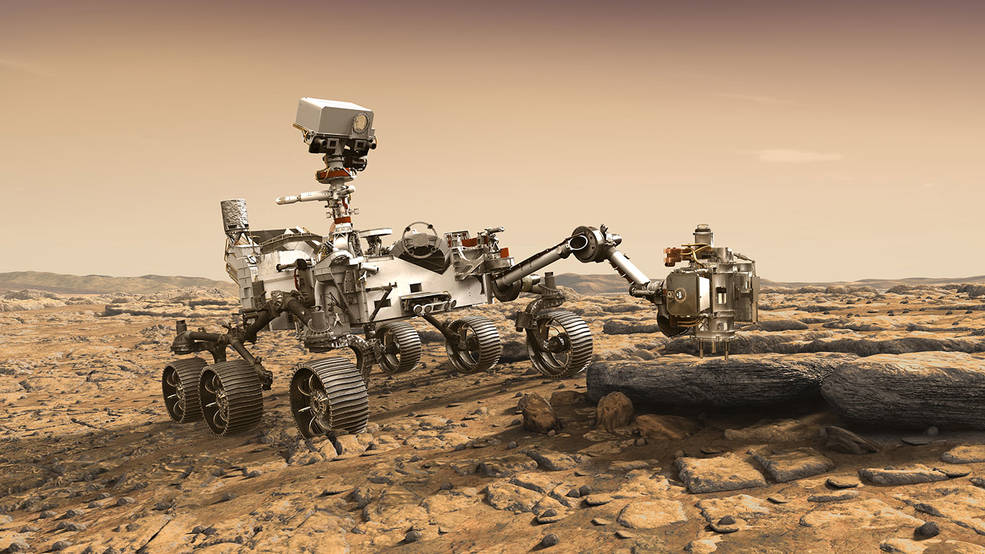
 -  3056  -  PERSEVERANCE  -  the rover has safely landed.   It is the most technologically advanced rover that humans have set on the Mars surface. . The Mars 2020 Mission will use five new technologies to help future missions on Mars, both crewed and uncrewed. Two of these are technology demonstrations.


---------------  3056  -  PERSEVERANCE  -  the rover has safely landed.    

-  The Perseverance rover has landed on Mars,  February 18, 2021. Perseverance is the largest and the most complex rover built by NASA.

-

-   Every 1.5 years, Earth and Mars are in such a configuration that reduces the travel time from nine months to seven months. That’s why two countries, the UAE and China, also launched their respective missions to Mars.

-

-  “MEDLI2” is the abbreviation of “Mars Entry, Descent, and Landing Instrumentation 2“.   The spacecraft takes seven minutes to land on Mars after it enters its atmosphere. These seven minutes are the most challenging part of the mission. Since Mars is about 14 “light minute”  away, it takes 14 minutes for the signals to reach Mars. Hence, we cannot control the rover’s landing in real-time from the control room. The entire system is computerized.

-

-    MEDLI2 has electronic devices that will be active during the EDL. The spacecraft will enter Mars’ atmosphere traveling at about 12,500 miles per hour. MEDLI2 will collect data during the last seven minutes of flight, leading up to when the rover lands on the surface of Mars. 

-

-  Similar technology was first used during the landing of the Curiosity rover in 2012. The 2012 landing data raised several important questions that will be answered in the 2021 Entry, Descent and Landing of Perseverance.

-

-   Since the EDL is the most crucial part of the mission, there is no margin of error, and every piece of data is significant. 

-

-  TRN is the short form of “Terrain Relative Navigation“.   To ensure a future for the rover, it must land in a safe place. During the Apollo moon landings, astronauts sighted landmarks for landing and looked out the window during the final descent to avoid craters and boulder fields and land safely.

-

-  TRN will take pictures of the landing zone, compare them with the maps prepared from previous orbital missions, and divert the spacecraft if necessary.

-

-  MEDA stands for the “Mars Environmental Dynamics Analyzer“. Mars is a dusty world. Dust dominates Mars’ weather the way that water dominates Earth’s weather. The dust storms on Mars can sometimes cover the entire planet. 

-

- In 2018, we lost communication with the Opportunity rover, due to a raging dust storm. Nicknamed Oppy, the rover served for about 14 years and was one of the best-performing rovers on Mars.

-

-  MEDA is a suite of environmental sensors designed to record dust optical properties and six atmospheric parameters: wind speed/direction, pressure, relative humidity, air temperature, ground temperature, and radiation in discrete bands of the UV, visible, and IR ranges of the spectrum. 

-

-  MEDE sensors are located on the rover’s mast “neck” and on the deck, front, and interior of the rover’s body. The 12-pound instrument is expected to return 11 megabytes of data to help us explore weather conditions on Mars.

-

-  It is a crucial part of the mission as it will help future astronauts know what weather conditions they’ll face on Mars. Their safety depends on accurate weather predictions.  MEDA as a  simple abbreviation spells two Spanish words that can be roughly translated as “give me,” as in “MEDA! Give me the weather, dust, and radiation report on Mars!”

-

-  MEDA will help prepare for human exploration by providing daily weather reports and information on the radiation and wind patterns on Mars.

-

-  “MOXIE”   stands for “Mars Oxygen In-Situ Resource Utilization Experiment“. When we talk about human-crewed Mars missions, we should plan for their safe return to Earth. Otherwise, it would be a suicide mission. 

-

-  For their safe return, we need a rocket. For the rocket to take off from the Martian surface, we need oxygen. Of course, we also need oxygen for our astronauts, but the amount of oxygen required as a fuel for rockets is far more than what they need for breathing. 

-

-  Taking such a large amount of oxygen from Earth would be an unrealistic idea. So we need to develop a technology for creating oxygen from the atmosphere of Mars, and MOXIE is the first step.

-

-  MOXIE will demonstrate how future explorers might produce oxygen from the Martian atmosphere for propellant and for breathing. The Martian atmosphere is completely different from Earth’s. 

-

-  Carbon dioxide makes up 96% of the gas in Mars’ atmosphere. Oxygen is only 0.13%, compared to 21% in Earth’s atmosphere.  We need to develop a way to convert carbon dioxide into oxygen. Is it possible? Well, the trees do that all day. The question is, can we do it? 

-

-  MOXIE will collect CO2 (carbon dioxide) from the Martian atmosphere, then electrochemically split the CO2 molecules into O2 (oxygen) and CO (carbon monoxide) at 800° C. The O2 is then analyzed for purity before being vented back out to the Mars atmosphere along with the CO and other exhaust products.

-

-  MOXIE is situated in the front-right of the rover. The 17.1 kilogram apparatus will run for one hour per experiment in which it is expected to produce up to 10 grams of oxygen. MOXIE is one of the two technology demonstrations. If this experiment turns out to be successful, NASA may dedicate a full-scale mission to this technology.

-

-  The Mars Helicopter is another technology demonstration and a major highlight mission. For the first time in history, a human-made object will enjoy a powered flight on another planet. 

-

-  The 1.8-kilogram helicopter has been named “Ingenuity“.  We ope to learn  how it will fly in the fragile atmosphere of Mars. 

-

February 21, 2021       PERSEVERANCE  -  the rover has  landed       3056                                                                                                                                                          

----------------------------------------------------------------------------------------

-----  Comments appreciated and Pass it on to whomever is interested. ---- 

---   Some reviews are at:  --------------     http://jdetrick.blogspot.com -----  

--  email feedback, corrections, request for copies or Index of all reviews 

---  to:  ------    jamesdetrick@comcast.net  ------  “Jim Detrick”  -----------

--------------------- ---  Sunday, February 21, 2021  ---------------------------


3055 - EARTH - magnetic pole shift.

 -  3055  -   EARTH  -  magnetic pole shift.   The temporary breakdown of Earth's magnetic field 42,000 years ago sparked major climate shifts that led to global environmental change and mass extinctions.  The Earth suffered electrical storms, widespread auroras, and cosmic radiation, all triggered by the reversal of Earth's magnetic poles.

----------------------  3055  -   EARTH  -  magnetic pole shift.

-  I always thought that my boy scout compass points north.   Well it does point that direction but several degrees off true geographic north.  The Earth’s spinning axis and magnetic axis are not perfectly aligned.  In fact the magnetic axis might flop north to south sometime in the future..  It happened 42,000 years ago.  Could happen again?  

- 

-  The temporary breakdown of Earth's magnetic field 42,000 years ago sparked major climate shifts that led to global environmental change and mass extinctions on the planet.

-

-  This dramatic turning point in Earth's history, laced with electrical storms, widespread auroras, and cosmic radiation, was triggered by the reversal of Earth's magnetic poles and resulting changing solar winds.

-

-  For the first time ever, we have been able to precisely date the timing and environmental impacts of the last magnetic pole switch.  These findings were made possible with ancient New Zealand kauri trees, which have been preserved in sediments for over 40,000 years.

-

-  Using the ancient trees science could measure, and date, the spike in atmospheric radiocarbon levels caused by the collapse of Earth's magnetic field.

-

-  While scientists already knew the magnetic poles temporarily flipped around 42,000 years ago (known as the 'Laschamps Excursion'), they didn't know exactly how it impacted life on Earth, if at all.

-

-  The researchers were able to create a detailed timescale of how Earth's atmosphere changed over this time by analyzing rings on the ancient kauri trees. The kauri trees are like the Rosetta Stone, helping scientists tie together records of environmental change in caves, ice cores and peat bogs around the world.

-

-  The researchers compared the newly-created timescale with records from sites across the Pacific and used it in global climate modeling, finding that the growth of ice sheets and glaciers over North America and large shifts in major wind belts and tropical storm systems could be traced back to this Event.

-

-  One of their first clues was that megafauna across mainland Australia and Tasmania went through simultaneous extinctions 42,000 years ago. This had never seemed right, because it was long after Aboriginal people arrived, but around the same time that the Australian environment shifted to the current arid state.

-

-  This helps explain other evolutionary mysteries, like the extinction of Neandertals and the sudden widespread appearance of figurative art in caves around the world.

-

-  The magnetic north pole, the direction a compass needle points to, doesn't have a fixed location. It usually wobbles close to the North Pole (the northern-most point of Earth's axis) over time due to dynamic movements within the Earth's core, just like the magnetic south pole.

-

-  Sometimes, the magnetic poles' movements can be more drastic. Around 42,000 years ago they swapped places entirely.  The Laschamps Excursion was the last time the magnetic poles flipped.  They swapped places for about 800 years before changing their minds and swapping back again.

-

-  Until now, scientific research has focused on changes that happened while the magnetic poles were reversed, when the magnetic field was weakened to about 28 per cent of its present-day strength.

-

-  But according to these findings, the most dramatic part was the lead-up to the reversal, when the poles were migrating across the Earth. Earth's magnetic field dropped to only 6 per cent strength during the Adams Event..


-  We essentially had no magnetic field at all our cosmic radiation shield was totally gone.


-  During the magnetic field breakdown, the Sun experienced several 'Grand Solar Minima' (GSM), long-term periods of quiet solar activity.  Even though a Solar Minimum means less activity on the Sun's surface, the weakening of its magnetic field can mean more space weather, like solar flares and galactic cosmic rays, could head Earth's way.

-

-  Unfiltered radiation from space ripped apart air particles in Earth's atmosphere, separating electrons and emitting light, a process called ionization.  The ionised air 'fried' the Ozone layer, triggering a ripple of climate change across the globe.

-

-  Dazzling light shows would have been frequent in the sky during the Adams Event.  Aurora borealis and aurora australis, also known as the northern and southern lights, are caused by solar winds hitting the Earth's atmosphere.

-

-  Usually confined to the polar northern and southern parts of the globe, the colorful sights would have been widespread during the breakdown of Earth's magnetic field.

Early humans around the world would have seen amazing auroras, shimmering veils and sheets across the sky.

-

-  Ionised air, which is a great conductor for electricity, would have also increased the frequency of electrical storms.  These dramatic environmental changes may have caused early humans to seek more shelter. This could explain the sudden appearance of cave art around the world roughly 42,000 years ago.

-

-  We think that the sharp increases in UV levels, particularly during solar flares, would suddenly make caves very valuable shelters.  The common cave art motif of red ochre handprints may signal it was being used as sunscreen, a technique still used today by some groups.

-

-  The amazing images created in the caves during this time have been preserved, while other art out in open areas has since eroded, making it appear that art suddenly starts 42,000 years ago.

-

-  These findings come two years after a particularly important ancient kauri tree was uncovered at  Northland.  The massive tree, with a trunk spanning over two and a half meters, was alive during the Laschamps period.

-

-   Like other entombed kauri logs, the wood of these trees is so well preserved that the bark is still attached.   A specialist in dating tree-rings (dendrochronology) studied cross sections of the trees .

-

-  Using radiocarbon dating  the team tracked the changes in radiocarbon levels during the magnetic pole reversal. This data was charted alongside the trees' annual growth rings, which acts as an accurate, natural timestamp.

-

-  While the magnetic poles often wander, some scientists are concerned about the current rapid movement of the north magnetic pole across the Northern Hemisphere.  This speed, alongside the weakening of Earth's magnetic field by around nine per cent in the past 170 years, could indicate an upcoming reversal.

-

-  If a similar event happened today, the consequences would be huge for modern society. Incoming cosmic radiation would destroy our electric power grids and satellite networks.

The human-induced climate crisis is catastrophic enough without throwing major solar changes or a pole reversal in the mix.

-

-  Our atmosphere is already filled with carbon at levels never seen by humanity before. A magnetic pole reversal or extreme change in Sun activity would be unprecedented climate change accelerants.  Let’s hope history does not repeat itself.

-

February 21, 2021        EARTH  -  magnetic pole shift                    3055                                                                                                                                                          

----------------------------------------------------------------------------------------

-----  Comments appreciated and Pass it on to whomever is interested. ---- 

---   Some reviews are at:  --------------     http://jdetrick.blogspot.com -----  

--  email feedback, corrections, request for copies or Index of all reviews 

---  to:  ------    jamesdetrick@comcast.net  ------  “Jim Detrick”  -----------

--------------------- ---  Sunday, February 21, 2021  ---------------------------


Saturday, February 20, 2021

3054 - PERSEVERANCE - Mars mission with math

 -  3054  -   PERSEVERANCE  -  Mars mission with math.    The most advanced rover NASA has sent to another world touched down on Mars Thursday, February 18, 2021,  after a 203-day journey of 293 million miles.


---------------  3054  -   PERSEVERANCE  -  Mars mission with math 

-   Perseverance is packed with new technology, the Mars 2020 mission launched July 30, 2020, from Cape Canaveral Space Force Station in Florida. The Perseverance rover mission marks an ambitious first step in the effort to collect Mars samples and return them to Earth.

-

-  About the size of a car, the 2,263-pound (1,026-kilogram) robotic spacecraft will undergo several weeks of testing before it begins its two-year science investigation of Mars' Jezero Crater.

-

-   While the rover will investigate the rock and sediment of Jezero's ancient lakebed and river delta to characterize the region's geology and past climate, a fundamental part of its mission is astrobiology, including the search for signs of ancient microbial life. 

-

-  The Mars Sample Return will allow scientists on Earth to study samples collected by Perseverance to search for definitive signs of past life using instruments too large and complex to send to the Red Planet.

-

-   Perseverance is the first step in bringing back rock and regolith from Mars.  They could tell us if life might have once existed beyond Earth.

-

-  Some 28 miles wide, Jezero Crater sits on the western edge of Isidis Planitia, a giant impact basin just north of the Martian equator. Scientists have determined that 3.5 billion years ago the crater had its own river delta and was filled with water.

-

-  Equipped with seven primary science instruments, the most cameras ever sent to Mars, and its exquisitely complex sample caching system Perseverance will scour the Jezero region for fossilized remains of ancient microscopic Martian life, taking samples along the way.

-

-   Perseverance is the most sophisticated robotic geologist ever made, but verifying that microscopic life once existed carries an enormous burden of proof.   While we'll learn a lot with the great instruments we have aboard the rover, it may very well require the far more capable laboratories and instruments back here on Earth to tell us whether our samples carry evidence that Mars once harbored life.

-

-   The rover not just to land but to find and collect the best scientific samples for return to Earth, and its incredibly complex sampling system and autonomy not only enable that mission, they set the stage for future robotic and crewed missions.

-

-  The “Mars Entry, Descent, and Landing Instrumentation” 2 (MEDLI2) sensors collected data about Mars' atmosphere during entry, and the Terrain-Relative Navigation system autonomously guided the spacecraft during final descent. The data from both are expected to help future human missions land on other worlds more safely and with larger payloads.

-

-  On the surface of Mars, Perseverance's science instruments, “Mastcam-Z”  a pair of zoomable science cameras on Perseverance's remote sensing mast, or head, will create high-resolution, color 3D panoramas of the Martian landscape.

-

- The SuperCam on the mast uses a pulsed laser to study the chemistry of rocks and sediment and has its own microphone to help scientists better understand the property of the rocks, including their hardness.

-

-  Located on a turret at the end of the rover's robotic arm, the “Planetary Instrument for X-ray Lithochemistry” (PIXL) and the “Scanning Habitable Environments with Raman & Luminescence for Organics & Chemicals” (SHERLOC) instruments will work together to collect data on Mars' geology close-up. 

-

-  PIXL will use an X-ray beam and suite of sensors to delve into a rock's elemental chemistry. SHERLOC's ultraviolet laser and spectrometer, along with its “Wide Angle Topographic Sensor for Operations and eNgineering’ (WATSON) imager, will study rock surfaces, mapping out the presence of certain minerals and organic molecules, which are the carbon-based building blocks of life on Earth.

-

-  The rover chassis has three science instruments. The “Radar Imager for Mars' Subsurface Experiment” (RIMFAX) is the first ground-penetrating radar on the surface of Mars and will be used to determine how different layers of the Martian surface formed over time. The data could help pave the way for future sensors that hunt for subsurface water ice deposits.

-

-  The “Mars Oxygen In-Situ Resource Utilization Experiment” (MOXIE) technology demonstration will attempt to manufacture oxygen out of thin air, the Red Planet's tenuous and mostly carbon dioxide atmosphere.

-

-   The rover's “Mars Environmental Dynamics Analyzer” (MEDA) instrument, which has sensors on the mast and chassis, will provide key information about present-day Mars weather, climate, and dust.

-

-  Currently attached to the belly of Perseverance, “Ingenuity Mars Helicopter” is a technology demonstration that will attempt the first powered, controlled flight on another planet.

-

-  Project engineers and scientists will now put Perseverance through its paces, testing every instrument, subsystem, and subroutine over the next month or two. Only then will they deploy the helicopter to the surface for the flight test phase. If successful, Ingenuity could add an aerial dimension to exploration of the Red Planet in which such helicopters serve as a scouts or make deliveries for future astronauts away from their base.

-

-  Once Ingenuity's test flights are complete, the rover's search for evidence of ancient microbial life will begin in earnest.

-

-   A primary objective for Perseverance's mission on Mars is astrobiology research, including the search for signs of ancient microbial life. The rover will characterize the planet's geology and past climate and be the first mission to collect and cache Martian rock and regolith, paving the way for human exploration of the Red Planet.

-

-  Subsequent NASA missions, in cooperation with ESA, will send spacecraft to Mars to collect these cached samples from the surface and return them to Earth for in-depth analysis.

-

-  The Mars 2020 Perseverance mission is part of NASA's Moon to Mars exploration approach, which includes Artemis missions to the Moon that will help prepare for human exploration of the Red Planet.  Kepler started this exploration over a century ago.

-

-   The mass of the Mars by using Kepler’s Third Law:

-

------------------------------  p^2  =   constant * a^3

-

----------------------------  period^2  =  (constant)  *  radius^3

-

-----------------------------    p^2  =   (4 pi^2 / G*M) * a^3


-------------------------------   M   =   (4 * pi^2 / G) * ( a3 / p^2)    

-

-  where G is Newton’s constant of gravity equal to 6.67*10^-11 m^3 / kg sec^2

-

---------------------   M is the mass of the planet in kilograms,

-

---------------------  a is the average orbit radius in meters 

-

--------------------- T is the orbit period in seconds.

 -

-  The martian moon Phobos was observed from Earth through  telescopes to have an orbit radius of 9,380 km and a period of 0.32 days,

-

-------------------------   What is the mass of Mars?

-

-------------------------   M = (4*pi^2 / G ) ( (a3 / p2). 

-

-------------------------   a = 9380 km * 1000m / km = 9.38*10^6 m 

-

-------------------------  p = 0.32 days * 24h / d * 3600 s / hr = 27,648 seconds, 

-

--------  M = [4 * (3.141)^2 / 6.67x10^-11] (9.38*10^6)^3 / (27,648)^2 = 6.39x10^23 kg.

-

------------------- The mass of Mars  = 6.39x10^23 kg.

-

------------------  The mass of Earth  = 59.7x10^23 kg.  (Over 9 times more massive.)

-

-  The martian moon Diemos has an orbit period of 1.26 days. What is its orbit radius from the center of Mars in kilometers ?

-

-   We know M and p and need to solve for a:  

-

------------------------------  a^3 = GM p^2 / 4pi^2

-

------------------------------   p = 1.26d *24h  / d * 3600 s / h = 108,864 seconds, 

-

--------------  a^3 = (6.67*10^-11)(6.39*10^23)(108,864)^2/(4 * 3.141^2) = 1.27x10^22 

-

-----------------------------   a = 23,352 kilometers 

-

--------------------------  Diemos  orbital radius is 23,400 kilometers

-

---------------------------  Diemos  orbital radius is 14,500 miles

-

---------------------------  Earth  orbital radius is 93,000,000 miles

-

-   On March 10, 2006, the “Mars Reconnaissance Orbiter” (MRO) was originally placed into a very elliptical orbit with a period of 35.5 hours and an average radius of 25,889 km. What is the mass of Mars based on this orbit?

-

-  Its final orbit was achieved in September 2006 with a “circular radius” of 3,700 km.

-

- What is the final orbit period in minutes of MRO in the new circular orbit?

-

-------------------    p2= (4pi^2 / GM) a^3

-

-------------------   a = 3,700,000 meters 

-

-------------------  M = 6.39*10^23 kg 

-

-------------------   p2 = 4.69*10^7

-

 ------------------  p = 6,848 seconds  

-

-------------------  orbital period  =   114 minutes.

-

-  It takes a little less than 2 hours to complete one orbit around Mars.  Knowing all this math results from previous missions is allowing Perseverance to land safely on the surface today.  But, lots more math is involved with the 4 past years of engineering.

-

February 19, 2021      PERSEVERANCE  -  Mars mission                3054                                                                                                                                                          

----------------------------------------------------------------------------------------

-----  Comments appreciated and Pass it on to whomever is interested. ---- 

---   Some reviews are at:  --------------     http://jdetrick.blogspot.com -----  

--  email feedback, corrections, request for copies or Index of all reviews 

---  to:  ------    jamesdetrick@comcast.net  ------  “Jim Detrick”  -----------

--------------------- ---  Saturday, February 20, 2021  ---------------------------


Thursday, February 18, 2021

3053 - ATOMS - spooky action for clocks?

 -  3053  -   ATOMS  -  spooky action for clocks?    Physicists imagine a day when they will be able to design a clock that's so precise, it will be used to detect subtle disturbances in space-time or to find the elusive dark matter that tugs on everything yet emits no light. The ticking of this clock will be almost perfect.

-------------------------  3053 -  ATOMS  -  spooky action for clocks?  

-  Physicists imagine a day when they will be able to design a clock that's so precise, it can detect dark matter.

-

-  The clock will be used to detect subtle disturbances in space-time or to find the elusive dark matter that tugs on everything yet emits no light.

-

-  Researchers has created a clock that, with some tweaks, could be four to five times more precise than the world's best clocks. To put that into perspective, if today's most precise clocks started ticking at the birth of the universe, they would be off by only half a second today; with more improvements, this new clock has the potential to be off by only 0.1 second. 

-

-  Atomic clocks tick according to the movement of atoms. Since the 1960s, the atomic clocks that are responsible for keeping global time and defining "a second" are based on cesium atoms; these clocks bombard cesium atoms with microwaves and measure time as electrons oscillate from a lower energy level (called a ground state) to a higher one (an excited state). 

-

-  Researchers have developed "optical clocks" that are 100 times more precise than cesium atomic clocks. These clocks use lasers to excite atoms of elements such as aluminum or ytterbium; visible light has a higher frequency than microwaves and thus can excite atoms to oscillate 100,000 times faster than microwaves can excite cesium atoms.

-

-   This faster oscillation adds more data points to the measurement of a second, making it more precise. Soon, there will be an official "redefinition of the second" using these much more precise optical clocks. 

-  

-  But even these nearly faultless optical atomic clocks cannot measure time perfectly, because they fall victim to the rules of quantum mechanics, the strange rules that govern the zoo of subatomic particles.

-

-   The atoms that run the clock are so small that their states can't be pinned down precisely, so they are defined by probabilities. Therefore, an electron isn't in an excited state or a ground state, but it has some probability of being in multiple energy levels at once.

-

-  Trying to measure the state of a single atom is like flipping a coin, as the actual measurement "forces" the atom to choose either the ground state or the excited state, but "you never find something in between“. This uncertainty in measurement makes it impossible to tell perfect time. 

-

-  When you increase the number of atoms in the clock (which can be thought of as the number of coin tosses) and start taking the average of how many are excited and how many are not, measurements start to become more precise.

-

-  The more atoms you add, the smaller your error in measurement or uncertainty what the "standard quantum limit" will be. Because the precision of the measurement scales as the square root of the number of coin tosses, throwing 10,000 coins is 10 times more precise than throwing 100. 

-

-  That's why today's optical clocks measure time by averaging the oscillations of thousands of atoms. But even that method can't get rid of the standard quantum limit.

-

-  Quantum entanglement, or "spooky action at a distance," as Albert Einstein famously called it, is the idea that the fates of tiny particles are linked to each other even if they're separated by long distances.

-

-   So, by entangling the atoms that keep time, the scientists might be able to keep each pair or group of entangled atoms in the same state and thus oscillating at similar frequencies, thereby allowing the clock to overcome the standard quantum limit and measure time more precisely.

-

-  Entangling the atoms makes the tosses less random, so to speak.  The toss of each atom individually is still random, but all the tosses together have less randomness than those of independent atoms.  

-

-  It is similar to placing 100 coins on a table, 50 heads up and 50 tails up. If you pick up any coin without looking, it will be randomly heads or tails. But once you pick up all the coins, there will be exactly equal numbers of heads and tails.

-

- The research team placed 350 atoms of ytterbium between two mirrors. Then, they fired a laser beam that bounced back and forth between the mirrors. As the light hit the first atom, the atom altered the light. That light then altered the second atom, and then the third and then the rest, until they all became entangled and started oscillating with similar phases. Then, the team used another laser to measure the average frequency at which these atoms oscillated. 

-

-   When the team ran two experiments, one with entangled atoms and one without, they found that the entangled atoms were able to measure time at the same precision, but four times faster. They also found that when the two clocks measured for the same amount of time, the entangled clock was more precise.

-


-  Extremely precise clocks may eventually have applications beyond telling time. Time depends on gravity.   Because of relativity, massive objects (which have a higher gravitational force) warp space-time, slowing time down. 

-

-  So, if you have two clocks and lift one of them 1 foot  higher, at these two heights, time actually runs differently.  As these clocks become more precise, they might be used to detect how time changes, thereby detecting subtle gravitational effects in the universe, such as ripples in space-time known as gravitational waves. 

-

-  Because dark matter also exerts gravitational pull, minute changes in the ticking of time could reveal the nature of the dark matter that surrounds us.

-

-  There's even speculation that so-called absolute constants in the world of physics, such as the speed of light or the charge of electrons, may change as the universe expands. 

-

-  And because these constants define the laws of physics that govern the energy levels in an atom, they may also change the measurement of time. So it's possible that the very essence of time changes as the universe expands.  ----------------  other Reviews;

-

-  3027 -  ATOMS  -  how fine structure constant works?  -  This is a 100 year story of how physicists were able to figure out the mathematics that defines the behavior of an atom.  They are still figuring, but, we have come a long way.  One of the biggest issues was infinity, which is a very long way. 

-  

-  3014 -  ATOM  -  Nuclear Forces and Electron Volts?  The Cosmic Ray is a proton traveling at nearly the speed of light.  It was flung out of a galaxy that was 12 million lightyears away.  It was so near light speed that after 12 million lightyears it was only behind a photon, released at the same time,  by 46 nanometers.  Because Relativity slows time at light speed the Cosmic Ray has only experienced 20 minutes of flight.

-

-  2952  -  ATOM  -  what happens on the inside?   No one really knows what happens inside an atom. But two competing groups of scientists think they've figured it out. And both are racing to prove that their own vision is correct.  Here's what we know for sure: Electrons whiz around "orbitals" in an atom's outer shell. Then there's a whole lot of empty space. Right in the center of that space, there's a tiny nucleus, a dense knot of protons and neutrons that give the atom most of its mass.

-

--   2913  -  ATOM  -  can we see an atom?   Well, that really depends on what we mean by “see.” We see something when light emitted or reflected from an object reaches our eyes and the signal is conducted to our brain. 

-

-  2867  -  ATOM  - and the electron cloud?  The picture of the atom you were taught in high school is wrong, mainly because electrons aren’t point-like particles.  Electrons are a‘fuzzy’ . They are tough to pin down due to their ‘Quantum Wave Function’, which is a complicated way of saying they exist as a field of “probability“, not as an individual particle. 

-

-  2709 -  ATOMS  -  measuring how atoms work?  -  An atom can be viewed as a tiny electron orbiting a tiny nucleus at a certain radius.  Let’s start with the hydrogen atom which is a single proton orbited by a single electron.  

-

-  2694  -  ATOM  -  How can mathematics tell us how an atom works?  It is 100 years of discovery.  -  It is how physicists were able to figure out the mathematics that defines the behavior of an atom.  They are still figuring, but, we have come a long way. 

-

- 2685  -  MOLECULE  -  how a molecule works?  When there is more than one proton in the nucleus and more than one atom in orbit this classical physics math just becomes overwhelming.  That is the reason the math of Quantum Mechanics was invented. When Quantum Mechanic’s math is used, the concept of the electron orbiting the proton completely disappears.  The electron’s position around the nucleus becomes a probability distribution

-

-  2377 - ATOM  -  defining the atom  All the other elements in the periodic table above hydrogen and helium were created in the nuclear fusion of the stars  The first stars formed with only hydrogen and helium.  When they burned all their fuel and exploded as supernova they splattered the surrounding space with all the atoms in the higher level elements.  

-

-  2333  -  Rainbows can tell us what the Universe is made of.  Introduction to the science of spectroscopy.

-

-  2318  -  Brownian motion from atoms you can not see.    My grandson, Michael, was 9 years old when he was looking at pond water under his microscope.  He could see small plants and animals moving around in the water.  But, he also saw all the little pieces of dust jiggling, almost vibrating, in a zigzag manner.  He asked me what causes everything to move like that?


-  2315  -   About how atoms were first discovered.  How was the atom discovered,  This review covers the first 100 years of discovery that started in 1808.  John Dalton conclusively argued for the existence of the indivisible atom, and at the same time as Einstein was provided a way to directly measure those atoms, Thomson and Rutherford discovered that the atom wasn't indivisible at all. Instead, it was made of even tinier bits

-

-

February 18, 2021      ATOMS  -  spooky action at for clocks?             3053                                                                                                                                                          

----------------------------------------------------------------------------------------

-----  Comments appreciated and Pass it on to whomever is interested. ---- 

---   Some reviews are at:  --------------     http://jdetrick.blogspot.com -----  

--  email feedback, corrections, request for copies or Index of all reviews 

---  to:  ------    jamesdetrick@comcast.net  ------  “Jim Detrick”  -----------

--------------------- ---  Thursday, February 18, 2021  ---------------------------


3051 - PHYSICS - mysteries to be solved?

 -  3051  -  PHYSICS  -   mysteries to be solved?    -  We are all students if we are still learning, Right?  Well mysteries in science today are solutions for students in the future.  The science I refer to in this review is the broad look at astronomy and physics. 


--------------------------  3051   -  PHYSICS  -   mysteries to be solved?  

-   Astronomy as the science of the very big.  Physics as the science of the very small.  Astronomy uses the theory of Relativity, which is basically the theory of “gravity“.  Physics uses the theory of Quantum Mechanics, which is basically of particle physics and ‘uncertainty”.

-

-  In the world of “big things” space and time, matter and energy appear to be “continuous” properties.  But, they are not.  Because if we look at them closely enough they enter the world of “small things” which are all quantisized, that is they come in discrete packages, or quantums, that are not continuous. 

-

-   Space can be quantisized to packets that are 10^-35 meters in size.  Time can be quantisized to packets of 10^-43 seconds duration.


-  When you use today’s math on the quantisized packages you enter the world of “uncertainties”  These small things can only be described in terms of “probabilities“.  It is only when we add them up into big things with many uncertainties cancelling out that we have what appears in our big world to be continuous and certainties.

-

-    The 1st mystery is how to describe matter and energy as quantum equations using these probabilities.  We can do Quantum math for space, length, and distances.     We can do Quantum math for time and therefore velocity and acceleration. We have Quantum math for light, or photons.  But we do not have math for Quantum gravity, matter and energy.  

-

-  The 2nd mystery is that Relativity produces math for gravity if it is viewed as the warping of space and time.  Quantum Mechanics needs gravity to be an exchange of particles, called gravitons, similar to photons.  We just do not have a  way to merge the theory’s contradictions between Relativity and Quantum gravity.  

-

-  A 3rd mystery is a composition of the Universe that appears to be 95%  Dark Matter and Dark Energy.  We call it “dark” because we can not see it and so far do not know what it is. 

-

-   That leaves only 5% of the Universe that is everything we can see and can make science out of it.  The fundamental particles that make up this 5% of ordinary matter and energy are only 18 in number.  Particles like quarks, electrons, photons, gluons, bosons, etc.

-

-  A 4th mystery is why “uncertainty” appears to be a fundamental physical law.  When we enter the world of small things we can not determine the momentum (mass and velocity) and position at the same time.  The more certain we are about one property the less certain we are about the other.

-

-    This uncertainty is not just a measurement problem it is a physical law that causes all the equations to be expressed in terms of probabilities.  A poor analogy but one I will use is that if we measure accurately the velocity of a race car we can not know its position accurately.  If we measure its position accurately we can not know its velocity accurately.  The same uncertainty trade-off exists between measuring time and energy.

-

-  The 5th mystery is the one of “entanglement”.  When two particles are entangled it means that some property in one particle is tied to and instantly transmitted between the same property in another particle.  When the spin of one entangled particle is flipped, the spin of the other particle also flips, regardless of the distance between them. 

-

-   Called “action at a distance” the other particle could be on the other side of the galaxy, but, when one flips the other flips instantly.  Instantly is faster than the speed of light, thought to be impossible.

-

-  A 6th mystery is the Big Bang.  This mystery must somehow bring astronomy and physics back together.  If we run the clock backwards in an expanding Universe we get all matter and energy compressed together in a single speck of pure energy. 

-

-  Somehow the energy transformed itself into an expansion of space and time that evolved into the Universe we see today.  When we get close to the Big Bang the equations in physics do not work.

-

-  The 7th mystery is the mathematics of String Theory that does start to explain some of these mysteries but not all of them.  And, String Theory is not one theory but 5 theories that need to be consolidated into one theory. 

-

-  To make String Theory work you need 36 particles, double the number of 18 fundamental particles we know today.  Called “super symmetry”  it requires a pairing of every particle with a higher mass, or higher energy particle.

-

-   Our particle accelerators have not been able to discover any of these particles to date.  The math for String Theory also requires 10 dimensions, plus time.  Not just the 3 dimensions, plus time that we understand as spacetime.  We can not detect these extra dimensions because the strings are so small. 

-

-   If we took a single hydrogen atom and expanded it up to the size of the Milky Way Galaxy the strings in these extra dimensions would still be smaller that the diameter of a human hair.  

-

-   Think of these 7 extra dimensions as ‘degrees of freedom”  Space is 3 degrees of freedom.  Time is one degree of freedom.  But, other properties of particles could be charge, spin, polarity, that could offer other degrees of freedom, thus are the other dimensions.

-

-    The math in String Theory works because it treats each particle as a vibrating string.  The different vibrations and different configurations of the strings account for the different properties of the 36 particles in super symmetry.

-

-  There are currently 5 different theories in “String Theory”.  Because Perturbation theory is used in the math each theory depends on the assumptions used and the properties you start with.  The theories are Type I, IIA, IIB, HO, and HE.  There is one more theory that is designed to encompass all 5 of these theories and it is called M-Theory.

-

-  The 8th mystery is back to the Uncertainty Principle and the Wave-Particle Duality of all matter.   Wave-particle duality and the 2 slit experiment.  Put a single slit in a paper and shin a light through it on to a screen.  The image is a single white line.  Put two slits in the paper and the image is no longer 2 white lines.  It is a pattern of white lines and dark lines representing an interference pattern of a wave.  All solid matter appears solid to us but it is actually almost all empty space.

-   

-  The math says that the smaller the measurement the higher the energy it takes to measure it. 

-

-    w = h / p, where “w” is wavelength,  where “h” is Planck’s Constant. 

- 

------------------  “h”  = 6.625*10^-34 kilograms*meters^2/second, 

-  where “p” is momentum, which is the product of mass and velocity.  

-

-  Therefore wavelength =  6.6*10^-34 / mass * velocity. 

-

-   Wavelength is inversely proportional to mass.  The smaller the mass the greater the wavelength.

-

-------------  E = h*c / w,  where “E” = energy and “c” = the speed of light, c = 3*10^8 meters / second.  

-

-  Therefore wavelength = 2*10^-25 kilogram * meters^3 /  seconds^2 / Energy.

-

-    Wavelength is inversely proportional to Energy.    The greater the mass the smaller the wavelength and the greater the energy needed to measure it.

-

-   That is the reason the Large Hadron Collider, the particle accelerator operating in CERN, Switzerland, is so massive and uses so much energy.  All matter has waves and the smaller the mass the bigger the wavelength.  

-

-  A baseball has a wavelength of less than the width of a proton.  So, the batter can not see the uncertainty probabilities associated with the wave when he hit’s the ball.

-

-    However, an electron has a wave for its mass that is equal to its size.  Therefore an electron’s position is always one of probabilities as to where it is at any point of time.

-

-  A 9th mystery is the mystery of consciousness.  How are our brains working at the quantum level of probabilities and uncertainties?  We are because we think, but, how do we really think?

-

-  A 10th mystery is called the Anthropic Principle.  The Universe is composed of 20 natural constants that are always the same everywhere in the Universe.  We have no way of deriving these constants except by experiments and measurements.  None have ever been derived mathematically.  

-

-  The Gravitational Constant is 6.674215*10^-15 meters^2 / (kilogram * seconds^2). 

-

-   The speed of light is a Constant 2.998*10^8 meters / second.  

-

-  The mass of an electron is always and everywhere the same,  9.108*10^-31 kilograms.  The same with the other natural constants.  

-

-  The mystery is greater because there values are what they are for whatever reason.  But, if any one of them were changed by the slightest amount the Universe would not exist as we know it and carbon-based life as we know it would not exist either.  

-

-  We would not be here thinking about it if any of these constants were any different.  We are here because they are what they are, Thank God!

-

-----------------------  Other reviews that you might be interest in.  Available upon request:

-

-  938  Universal Constants.  What are the natural constants and how do they shape our Universe.

-

-  2882  - Physics the Way I Learned It.

-

-  2386  -  The Science of Physics.  How all of physics can be narrowed down to two simple topics.

-

-  2004  -  The Trouble with Physics.  How string theory and academics have lead physics astray.

-

-  531 Joseph Henry, an American teacher.

-

-  532  Robert Millican, a Physics teacher.

-

-  524  Physics keeps getting simpler.  If you ask a stupid question you feel stupid.  If you don’t ask a stupid question you remain stupid.

-

- 2220  -  The laws of motion.

-

February 17, 2021      PHYSICS  -   mysteries to be solved?       1183         3051                                                                                                                                                          

----------------------------------------------------------------------------------------

-----  Comments appreciated and Pass it on to whomever is interested. ---- 

---   Some reviews are at:  --------------     http://jdetrick.blogspot.com -----  

--  email feedback, corrections, request for copies or Index of all reviews 

---  to:  ------    jamesdetrick@comcast.net  ------  “Jim Detrick”  -----------

--------------------- ---  Thursday, February 18, 2021  ---------------------------


3052 - UNIVERSE - The Evolution of the Universe?

 -  3052  -  UNIVERSE  -  The Evolution of the Universe,  The laws of physics say gravity is generated by matter and energy.  The laws of physics in Quantum Mechanics say that vacuum energy could be the repulsive force of Dark Energy.  However, the Quantum Mechanics math we know today calculates a force that is off by 55 orders of magnitude. 

-------------  3052  -  UNIVERSE  -    The Evolution of the Universe?

-  The Cosmic Microwave Background radiation (CMB) is a snapshot of the Universe at age 380,000 years.  The image is a sphere of space and galaxies with the Earth located at the center.

-

-  In 1998 astronomers expected to find that the Universe’s expansion was slowly decelerating due to the constant attractive pull of gravity.  To their surprise they learned the opposite.  The Universe expansion was accelerating , expanding even faster with time.

-

-  Since the Big Bang the Universe has been expanding, thinning out, and cooling down.  The Cosmic Inflation that occurred in the first seconds after the Big Bang assured that the Universe appears flat and uniform from our vantage point.  

-

-  Only by expanding for a brief period faster than the speed of light could the opposite ends of the Universe have been in contact and have the uniform temperature and density we see today.  At first discovery the  CMB radiation appeared perfectly uniform in all directions.

-

-  As the Universe cooled matter condensed out of this brew of energy like glacial ice freezing on the ocean.  Over millions of years stars, galaxies and blackholes formed.  The Universe has cooled to 2.7 Kelvin temperature from its 3,000 Kelvin temperature that it had at the time it released the radiation the first time 380,000 years after the Big Bang. 

-

-   The 2.7 Kelvin radiation proved to not be perfectly uniform.  When precision measurements were later made astronomers were able to detect 1 part in 100,000 variation in temperatures. The CMB image changed from perfectly uniform to pock marked image of hotter and cooler variations spreading at about 1 arc second for each wave.

-

-  Further study of these slight temperature variations detected sound waves and harmonic waves that allowed astronomers to calculate the age of the Universe,( 3,700,000,000 years), the composition ( Dark Matter, Dark Energy, Ordinary Matter, and radiation) and the geometry ( the Curvature of Space is flat).  

-

-   This is like studying the overtones of a violin and determining its age, type of wood, and geometry and concluding that it must be a Stradivarius violin.  The waveforms were slight temperature variations that corresponded to slight compressions and rarefactions of the gas caused by the propagation of the sound wave. 

-

-   The compressions became attractive forces for gravity.  The denser regions coalesced and eventually evolved in to stars and galaxies.

-

-  There is a Horizon Problem in today’s Universe because it is so uniform.  If you look to galaxies in one direction and to galaxies in the opposite direction they are similar.  But, there is no way light could have been transmitted between them.  They were too far apart to have possibly communicated and to have the same uniform temperatures.

-

-   The Theory of Cosmic Inflation solves this problem because these regions were in contact at an instant in time immediately after the Big Bang.  They are afterwards separated by rapid Cosmic Inflation that expanded space faster than the speed of light.

-

    The smallest Quantum Mechanics fluctuations in the original plasma became explanations for the slight temperature variations in the CMB seen today.

-

-  The angular width of the variations of the CMB is about 1 arc degree, about twice the width of the Full Moon in the sky.  The diameter of this 1 arc degree at age 380,000 years was 1 million lightyears.

-

-    Because the Universe has expanded by a factor of 1,000 each region today is one billion lightyears across.  Since the year 380,000 the photons of the CMB have traveled for 13,700,000,000 years.  Accounting for the expanding Universe they have traveled a distance of 45,000,000,000 lightyears.

-

-  The sound wave in the CMB precisely has a half wavelength of 180 degrees.  This implies that the spatial curvature of the Universe is flat.  If it were more than 180 degrees the curvature would be spherical.  If it were less than 180 degrees the curvature would be saddle shaped.   The flatness also supports the Theory of Cosmic Inflation because the Universe has expanded so much it appears flat to us.

-

-  Because the spatial geometry is dependent on the energy density the average must be near the “Critical Density’ of 10^-29 grams per cubic centimeter.  The Critical Density is the density of mass and gravity that would just balance the expansion of the Universe so it would stop expansion, but not begin compression. 

-

-  The amplitudes of the overtones, or harmonics, of the sound wave tell astronomers the strength of gravity required.  Both Ordinary Matter and Dark Matter create the effects of gravity. 

-

-   The calculations conclude the Ordinary Matter that make up our total world comprise only 5% of the mass-energy in the Universe.  Ordinary Matter is only 5% of the Critical Density needed in a Flat Universe.

-

-  Therefore, what astronomers can see in their telescopes is only 2% of the Universe.  What we can not “see” we must infer by its gravitational effects.

-

-  Astronomers expected gravity to be slowing down the expansion of the Universe.  Einstein’s equations would allow either a push or a pull form gravity, but, astronomers never considered the push.  In 1998 distant supernovae explosion were found to be dimmer than they should be.  The conclusion was that they were further away than the calculations said they were. 

-

-   Therefore the Universe must be expanding faster than expected and not slowing down at all.  It is not only expanding it is expanding at an ever increasing rate.

-

-  We have known the Universe is expanding for 75 years since Edwin Hubble discovered that galaxies were receding faster the further away they were.  Einstein equated this to the uniform expansion of space.  He  further expected it to be slowing down determined by the density of the matter-energy within it.  At the Critical Density the expansion would slow down and eventually stop at some infinite distance.


-  When it was discovered that there was an anti-gravity force accelerating the expansion of the Universe it was called “Dark Energy“.  Density of matter decreases as the volume of space increases.  But, most of the matter is Dark Matter and we are not sure how Dark Matter or Dark Energy changes over time, or with the continued dilution of space.

-

- Astronomers can tell if a galaxy with a given recession velocity is further away than expected because it is dimmer than expected.  If it were brighter than expected that would mean the expansion was decelerating.  

-

-  Type 1a supernova produce an explosion with a known “intrinsic luminosity“, that is, a known radiation per second output.  The redshift tells astronomers the recession velocity.  Compare this velocity with the apparent brightness for a large number of supernovae and you can produce a record of the Universe’s expansion.

-

-  Type 1a supernovae do not occur often so astronomers observe a large patch of sky containing thousands of galaxies.  They compare images night after night to see if a transient point of light appears.  The point of light is about 1 billionth as bright as the star, Sirius.

-

-    The results of these many observations have shown that the Universe was decelerating under the force of gravity for the first 5,000,000,000 years.   It has been accelerating under the force of Dark Energy over the last 5,000,000,000 years.  First Gravity was king, now Dark Energy is King.

-

-  The Acceleration of Dark Energy will determine what we can see in our Observable Universe over time.  If acceleration continues galaxies will disappear over the Observable horizon.  That is, their light does not have enough time to cover the distance to reach us. 

-

-   If expansion begins decelerating we will be always observing more of the Universe as the horizon of our Observable Universe moves outward.

-

-  The laws of physics say gravity is generated by matter and energy.  The laws of physics in Quantum Mechanics say that vacuum energy could be the repulsive force of Dark Energy.  However, the Quantum Mechanics math we know today calculates a force that is off by 55 orders of magnitude. 

-

-   If true the Universe would have completely flown apart eons ago.  A vacuum of empty space contains 10^-26 kilograms of energy per cubic meter.  This is too  small to explain accelerations so astronomers have proposed an energy field that somehow exists in the vacuum of space.  We do not know what could cause such a “field“.  Dark Energy is the name of a total mystery.

-

-  When gravity strength falls off with the square of the distance this is simply 3 dimensional geometry where the 2 dimensional surface of expanding sphere increases in area (dilution) as the square of distance., area = x^2.    Gravity is so weak compared to the other forces possibly it is leaking out into other dimensions. 

-

-   This is what string theory suggests.  The math of String Theory requires 11 dimensions, not just the 4 we are using in our spacetime math.  We have learned a great deal about the evolution of the Universe.  Obviously we need to learn a lot more.  There are too many mysteries to be solved.  ------------------------To learn more:

-

-  3037 - UNIVERSE -  your home is big place?  Amazing to know that shortly after the Big Bang, the universe was a relatively small, nearly infinitely dense place. It boggles the mind.  But that was 13,800,000,000 years ago. The expanding universe means the entirety of what we know is now incredibly large and is getting more immense every day. 

-  2428 - The Cosmological Constant

-

-  2550 -   The History of Cosmology

-

-  14 - The Universe is Flat

-

-  50 - Cosmology, What is Physics Telling Us?

-

-  767 -   Einstein’s Cosmology

-

February 17, 2021       UNIVERSE  -    The Evolution    1208          3052                                                                                                                                                          

----------------------------------------------------------------------------------------

-----  Comments appreciated and Pass it on to whomever is interested. ---- 

---   Some reviews are at:  --------------     http://jdetrick.blogspot.com -----  

--  email feedback, corrections, request for copies or Index of all reviews 

---  to:  ------    jamesdetrick@comcast.net  ------  “Jim Detrick”  -----------

--------------------- ---  Thursday, February 18, 2021  ---------------------------


Tuesday, February 16, 2021

Index of recent reviews

 -  3009 -   COSMIC  RAYS  -  and Dark Matter?  When the forces of gravity and electromagnetism compete inside a giant star, eventually gravity always wins and the star collapses. So the fact that dark matter is 80% of the mass in the universe, and not 99.99999%,  and regular matter is 20% as opposed to zero, strikes physicists as odd. 

-  3010 -   -  MARS  -  Perseverance  Mars mission?  Perseverance mission in 2021?  Space exploration just took the next giant leap in the search for signs of life beyond Earth.  On July 30, 2020 NASA launched its most sophisticated and ambitious spacecraft to Mars, the  “Perseverance rover“. 

-  3011  -     Launches and landing at sea has been a part of Musk long-term vision for SpaceX .  Elon  Musk is not just defining space launches he is redefining the auto industry.  He is redefining the battery?

 -  3012 -   TELESCOPE   -  Roman searches further?  - Hubble, Chandra, the Transiting Exoplanet Survey Satellite, telescopes have shed light on our place in our universe beyond the wildest imaginations. There is so much more to learn. Dark matter is thought to make up some 85 percent of the universe' total mass, dark matter has eluded our astronomers.

-  3013 -   SUPERNOVA  -  one explosion nearby?   At that same time, there was also an extinction event on Earth, called the “Pliocene marine mega fauna” extinction. Up to a third of the large marine species on Earth were wiped out at the time, most of them living in shallow coastal waters.

-  3014 -  ATOM  -  Nuclear Forces and Electron Volts?  The Cosmic Ray is a proton traveling at nearly the speed of light.  It was flung out of a galaxy that was 12 million lightyears away.  It was so near light speed that after 12 million lightyears it was only behind a photon, released at the same time,  by 46 nanometers.  Because Relativity slows time at light speed the Cosmic Ray has only experienced 20 minutes of flight.

-  3015 -   CONSTANTS  -  light to fine structure?    The strangest thing about the Universal Constants is that if any were even slightly different we would not be here.  If the Fine Structure Constant were to change even 4% carbon would not be produced in stellar fusion.  If it were 1% instead of 0.7%  all fusion would not take place in stars.  Universal Constants are strange numbers but you can thank your lucky stars they are what they are.

-  3016 -  PARTICLE  PHYSICS  - Phonons, Plasmons, and Magnons?    Phonons, Plasmons, and Magnons, you probably have not heard of these.  They are particles that appear in material when sizes are very small.  When we get into the very, very small all particles are also waves.  This is called a wave-particle duality in physics.  

-  3017 -   UNIVERSE  -  like Swiss Cheese?   The mission is to study the nature of Dark Matter for a better understanding of matter, space and time.   We are studying the Cosmic Microwave Background radiation with higher resolution and higher sensitivity. Telescopes integrated together with computers, are among projects designed to find the answers.  (See Review 3019 -  Telescopes  -  connect tem all together?)

-  3018 -  GALAXIES  -  the most distant galaxies?    Most of the galaxies in the Universe are “ over the horizon” and beyond what we can see.  Astronomers estimate that 98.4% of the galaxies in the Universe lie in the zone that we can never observe. (Unless we find something we can detect traveling faster that the speed of light.)

-  3019 -   TELESCOPES  -  connect them all together?  There is no one single sensor that can collect data in all of those different wavelengths at the same time.  Therefore, scientists have developed a many different instruments that are extremely good at collecting data in one specific spectrum, such as radio (ALMA), or mid-range infrared (James Webb). 

-  3020 -   ENERGY  an  abundance of alternatives?   The U.S. uses 4,000,000,000 kilowatts per year.  The world 17,000,000,000 kilowatts.  We need to pursue many different energy alternatives and let each one meet the market conditions for readily available, lowest cost energy.  

-  3022 - COSMOLOGICAL  CONSTANT  -  Einstein’s blunder?  Without the cosmological constant in the equation there is no term to counteract gravity and the Universe would collapse on itself.  With the term small enough the Universe would expand but gravity simply continuously slows the expansion into infinity.

-  3023 - MARS  - returning rock samples to Earth?  - Fundamental questions about Mars  remain related to its potential for life; the geological history of the planet; the history of its climate and the driving forces behind these changes; the evolution of geologic processes and the interior composition and structure; and more recent atmospheric, polar, surface, and interior processes. 

-  3024 -  UNIVERSE  -  a short story?   About 200,000 years ago, along came upright creatures capable of marveling at our mysterious universe and discovering how the whole thing came to be.  Here is their story.

-  3025 -   LASERS  -  a path to fusion power of stars?  The hope is that such research could lead to fusion power plants, which could provide energy without emitting greenhouse gases or hazardous nuclear waste.  These laser installations dedicate many of their experiments to pursuing fusion power.  Mimicking the stars.

-  3026 -  CASIMIR  -  force and vacuum energy?  -    How Vacuum Energy is affecting nanotechnology and expanding the Universe?

-  3027 -  ATOMS  -  how fine structure constant works?  -  This is a 100 year story of how physicists were able to figure out the mathematics that defines the behavior of an atom.  They are still figuring, but, we have come a long way.  One of the biggest issues was infinity, which is a very long way.   

-  3028 -  INTEREST  -  The Growth and Decay of Money?  Learn the math for the growth and decay of money.   Let’s study the growth of money.  The math is very interesting and it applies to many situations in nature that experience growth or decay.  It involves compound interest in the case of money.  In nature it is any continuous rate of change, usually with time.

-  3029 -  EQUATIONS  -  that affect the world?  How equations resulted from observations and inventing math.   Equations are observations that are put in mathematical terms.  Equations are discoveries.  Math is an invention, a powerful invention.  Equations allow you to predict accurately future results. 

-  3030 -  BRAIN  -  what creates consciousness?   -  How does the brain become a mind and create consciousness?    Human brains have figured out how the Sun shines, how life evolved from a single cell, why apples fall.  Our brains have built telescopes that see the galaxies as far back as the beginning of time. 

-  3031 -  KINETIC  ENERGY  -  the energy of motion?  The Universe is in constant motion.  how fast  is every thing moving in miles per hour.   The energy of motion is called Kinetic Energy.  The Universe is in constant motion in all directions and everywhere.  The Universe must be FULL of energy.  Constant motion is a natural state.

-  3032  -  KINETIC  ENERGY  -  defined.    It all starts with the law of the Conservation of Energy.  It is an amazing concept that Energy can neither be created nor destroyed.  Energy can only be changed from one form into another.  And, the Energy created in the Big Bang is the same Energy we have today.  It just got spread out quite a bit in the expansion of the Universe. 

-  3033  - ROCKET  REACTIONS -  what are the physics, the math? -   Rockets are very interesting if you want to learn physics.  Rocket designs get right down to the fundamentals. 

-  3034  -  NEUTRINO  DISCOVERIES   -  Neutrinos have a newly discovered method of interacting with matter, opening up ways to find them.  The neutrino is a confounding little particle that is believed to have played a major role in the evolution of our Universe.

-  3035  -  STARS  - How many stars are in the sky?   How many stars can you count on a clear night.  I sure you would estimate several thousand.  Astronomers have been fascinated with counting the stars for centuries.  Over recent decades they have even developed a mathematical formula for calculating the number of stars you can see.

-  3036  -  MAGNETAR  - The Brightest Flash in Our History.  December 27, 2005 the brightest flash of light in our history passed by Earth.  It originated over 50,000 years ago when, here on Earth, only 50 northern Europeans survived the ice age on Earth from which all Europeans are descendents. 

-  3037 - UNIVERSE -  your home is big place?  Amazing to know that shortly after the Big Bang, the universe was a relatively small, nearly infinitely dense place. It boggles the mind.  But that was 13,800,000,000 years ago. The expanding universe means the entirety of what we know is now incredibly large and is getting more immense every day. 

-  3038  -  REDSHIFTS  -  tells us how old it is?   The time that light has been traveling towards is  13 billion years.  Space has been expanding during that time.  Expanding space stretches out the wavelength of the light.  Longer wavelength are towards the red end of the light spectrum, thus the “ redshift” of light.

-  3039  -  ANTIMATTER  -  the opposite of normal matter?    "Antimatter." is just like normal matter, with all the same properties and all the same abilities to make up atoms and molecules, except for one crucial difference: It has an opposite charge

-  3040  -   EARTH  -  evolution of the Solar System?  - To carry our lineage back further this review is about the geological history of our Solar System.  We do not have many rocks to work with, a few meteorites, so the history lesson takes more imagination.  By studying the rocks, gas , and stars within 6,500 lightyears of Earth with detailed observations.

-  3041  -  QUANTUM  MECHANICS  -  controlling our reality?  This review discuss the strange world of Quantum Mechanics and suggests that it is really controlling our reality below the surface.  Quantum behavior may be what allows birds to fly thousands of miles with precise navigation.  It may be what allows plants to synthesize sunlight.  It may be what links your brain to eyesight.

- 3042  -  ELECTROMAGNETIC  WAVES  -  into light?   When studying electricity and magnetism science measured the forces and the relationships between charges and distances of separation.  These forces behaved very similar to gravity but much stronger.  When electric permittivity and magnetic permeability were defined it was discovered that the ratio of their product was the speed of light.  That is how science discovered that light was an electromagnetic wave.

-  3043  -  PLANETS  -  how many are out there?  We are content in thinking we have discovered the planets in our solar system.  We have eight planets circling he Sun.  Nine if you count Pluto.  Then more planetoids are being discovered orbiting farther from the Sun than Pluto.  

-  3044  -    EXOPLANET  -  Pegasi and Doppler shift astronomy?    The planet “51 Pegasi b” was discovered in 1995.  It was the first planet discovered orbiting a normal star, like our Sun.  When watching the star astronomers were able to detect a rhythmic wobble using the “Doppler Shift Technique.”

-  3045  -    EXOPLANETS  -  and the search or life?    Astronomers have been working hard adding the number of planets found to exist in other solar systems in our Milky Way Galaxy.  By 2020, astronomers have discovered over 4,000 planets in other solar systems.  1995 was when the first planet outside our own solar system was found. 

-  3046  -    ANTIMATTER  -  and the Higgs Boson discoveries?  Why is the universe is dominated by matter over antimatter, but there could be entire stars, and maybe even galaxies, in the universe made of antimatter. If the Universe did start out of ‘nothing”  then there is equal amounts of matter and antimatter that would come back together and annihilate each other back to “nothing” again.

-  3047  -    EINSTEIN  -  are his theories real life?  One of the most mysterious components in the entire Universe is “dark energy“, which wasn’t supposed to exist. We had assumed that the Universe was a balancing act, with the expansion of the Universe and the gravitational effects of everything within it fighting against one another. 

-  3048  -    SHOOTING  STARS  -  Out of the Galaxy?  If a star is traveling over 1,000,000 miles per hour it is referred to as a “hypervelocity star“.  Some 16 or these hypervelocity stars have been discovered.  The first one discovered in 2005 was traveling over 2,000,000 miles per hour.  In 2006 and 2007 seven more hypervelocity stars were discovered.

-  3049  -    DARK  MATTER  -  is real but what is it?    Dark matter is still an unconfirmed model, yet , the detractors have yet to convince the larger field of their ideas. And the latest evidence? It also suggests that dark matter is real.  But what is it?